Search

Showing posts with label Holocaust. Show all posts

08 July 2021

JOURNAL: Special Issue: Sexuality, Holocaust, Stigma (German History XXXIX (2021), No. 1 (March))

(image source: OUP)
 

Introduction: Sexuality, Holocaust, Stigma (Anna Hájková)

Understanding Sexual Violence during the Holocaust: A Reconsideration of Research and Sources (Regina Mühlhäuser)

Shared Intimacies: Women’s Sexuality in Foreign Workers’ Camps, 1940–1945 (Camille Fauroux)

Cross-dressing, Male Intimacy and the Violence of Transgression in Third Reich Photography (Jennifer Evans, Elissa Mailänder)

Sexual Violence against Men and Boys during the Holocaust: A Genealogy of (Not-So-Silent) Silence (Dorota Glowacka)

Sexual Barter and Jewish Women’s Efforts to Save their Lives: Accounts from the Righteous Among the Nations Archives (Katya Gusarov)

Between Love and Coercion: Queer Desire, Sexual Barter and the Holocaust (Anna Hájková)

Book reviews:

  • The Habsburg Monarchy, 1618–1815 (Christopher Wendt)
  • The German Right, 1918–1930: Political Parties, Organized Interests, and Patriotic Associations in the Struggle against Weimar Democracy (James McSpadden)
  • Freiheitliches Bürgertum in Deutschland. Der Weimarer Demokrat Eduard Hamm zwischen Kaiserreich und Widerstand (Larry Eugene Jones)
  • Project Europe: A History (Paul Betts)
  • Bowling for Communism: Urban Ingenuity at the End of East Germany (Marcus Colla)
  • Helmut Schmidt and British-German Relations. A European Misunderstanding (Jonathan Wright)
Read more with OUP.

10 June 2020

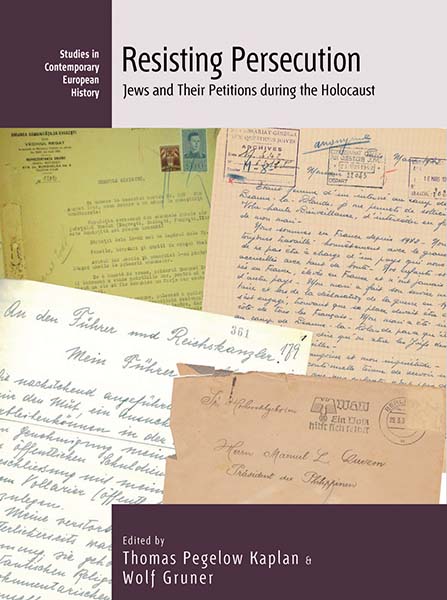
BOOK: Thomas P. KAPLAN and Wolf GRUNER, Eds., Resisting Persecution: Jews and Their Petitions during the Holocaust (New York - Oxford: Berghahn Books, 2020). ISBN 978-1-78920-720-0, $120.00


(Source: Berghahn Books)

Berghahn books is publishing a book on petitions by Jewish people during the Holocaust.

ABOUT THE BOOK

Since antiquity, European Jewish diaspora communities have used formal appeals to secular and religious authorities to secure favors or protection. Such petitioning took on particular significance in modern dictatorships, often as the only tool left for voicing political opposition. During the Holocaust, tens of thousands of European Jews turned to individual and collective petitions in the face of state-sponsored violence. This volume offers the first extensive analysis of petitions authored by Jews in nations ruled by the Nazis and their allies. It demonstrates their underappreciated value as a historical source and reveals the many attempts of European Jews to resist intensifying persecution and actively struggle for survival.

ABOUT THE EDITORS

Thomas Pegelow Kaplan is the Leon Levine Distinguished Professor and Director of the Center for Judaic, Holocaust, and Peace Studies at Appalachian State University. He is the author of The Language of Nazi Genocide (2009) and the co-editor of Beyond ‘Ordinary Men’: Christopher R. Browning and Holocaust Historiography (2019).

Wolf Gruner is the Shapell-Guerin Chair in Jewish Studies, Professor of History and Founding Director of the USC Shoah Foundation Center for Advanced Genocide Research at the University of Southern California. He is the author of nine books on the Holocaust, including Jewish Forced Labor under the Nazis (2006) and the prize-winning The Holocaust in Bohemia and Moravia (English edition 2019, German original 2016).

TABLE OF CONTENTS

List of Illustrations
Acknowledgments
Introduction
Thomas Pegelow Kaplan and Wolf Gruner
Chapter 1. To Not “Live as a Pariah”: Jewish Petitions as Individual and Collective Protest in the Greater German Reich
Wolf Gruner
Chapter 2. “Did We Not Shed Our Blood for France?” Identity and Resistance in Entreaties for the Jewish Internees of Occupied France, 1940–44
Stacy Renee Veeder
Chapter 3. Honorary Czechs and Germans: Petitions for Aryan Status in the Nazi Protectorate of Bohemia and Moravia
Benjamin Frommer
Chapter 4. Legal Resistance through Petitions during the Holocaust: The Strategies of Romanian Jewish Leader Wilhelm Filderman, 1940–44
Stefan C. Ionescu
Chapter 5. Attempts to Take Action In a Coerced Community? Petitions to the Jewish Council in the Lodz Ghetto during World War II
Svenja Bethke
Chapter 6. Petitioning Matters: Jews and Non-Jews Negotiating Ghettoization in Budapest, 1944
Tim Cole
Chapter 7. Global Jewish Petitioning and the Reconsideration of Spatial Analysis in Holocaust Historiography: The Case of Rescue in the Philippines
Thomas Pegelow Kaplan
Chapter 8. Petitioning for “Equal Treatment”: The Struggles of Intermarried Holocaust Survivors in Postwar Germany
Maximilian Strnad
Conclusion
Thomas Pegelow Kaplan and Wolf Gruner
Appendix: European-Jewish Petitions during the Holocaust
Bibliograhpy
Index

More info here

30 January 2014

CFA: New Research on Roma and the Holocaust (USHMM workshop)

What: New Research on Roma and the Holocaust, workshop, Call for Applicants

Where: Center for Advanced Holocaust Studies
United States Holocaust Memorial Museum

When: September 15-18, 2014


deadline: April 25, 2014

The United States Holocaust Memorial Museum’s Center for Advanced Holocaust Studies invites applications for a workshop, New Research on Roma and the Holocaust, scheduled for September 15-18, 2014. The program will consist of three days of consultation and discussion of participants’ research, followed by a day-long public symposium.
This workshop will bring together scholars working on Roma and the Holocaust across Europe, as well as histories of pre-war persecution and the effects of the Holocaust on Romani communities in its aftermath,  in order to foster scholarly cooperation on emerging research on these themes. The workshop will also introduce participants to the Museum’s extensive archival and other collections.
The Museum welcomes applications from doctoral candidates, postdoctoral scholars, and early career academics who are conducting research on Roma in the Holocaust. Proposals for new, original, and previously unpublished papers are welcome from scholars in all relevant academic disciplines. Researchers from post-Soviet states are particularly encouraged to apply. Successful applicants will be required to submit a copy of their presentation in English in advance of the workshop for circulation among commentators, other panelists, and participants. The workshop will be conducted in English.
A maximum of 14 scholars will be selected.  Applications must be submitted in English and include: (1) a current CV; (2) a statement addressing the candidate’s specific interest and background (including previous coursework, projects, publications, or language study) in the program’s area of study as well as how the workshop will benefit the candidate’s research; and (3) an abstract not to exceed 500 words of a paper to present at the workshop and public symposium. Applications should be sent to Krista Hegburg, Ph.D., Program Officer, Center for Advanced Holocaust Studies, U.S. Holocaust Memorial Museum, at khegburg@ushmm.org. The deadline for receipt of proposals is April 25, 2014.
The symposium organizers will provide lodging for the duration of the conference and a stipend to help defray transportation costs.  Participants are required to attend the full duration of the program.

More information available here

21 September 2013

CALL FOR PAPERS: Internatio​nal Conference​, "The Internatio​nal Tracing Service and Holocaust Scholarshi​p" (May 12-14, 2014)

What: International Conference, The International Tracing Service (ITS) Collections and Holocaust
Scholarship
 
Where: Washington, DC - United States Holocaust Memorial Museum
 
When: May 12-14, 2014
 
Deadline: 15 December 2013
 
 
Organizers:
Center for Advanced Holocaust Studies, United States Holocaust Memorial Museum
International Tracing Service, Bad Arolsen, Germany
 
Call for Papers
The Center for Advanced Holocaust Studies, United States Holocaust Memorial  Museum and the International Tracing Service invite applications for an international conference designed to  illustratethe broad academic research potential of the ITS collections. The conference will be held May 12-14, 2014 in Washington, D.C., at the United States Holocaust Memorial Museum.
Participants will present their papers in sessions open to the public and will also have the opportunity for discussion among the presenters on their experiences using the ITS archives.

The International Tracing Service (ITS) in Bad Arolsen, Germany, was, until November 2007, the largest closed archive in the world related to the Holocaust, forced labor, and Nazi persecution. Recently inscribed into the United Nations Educational, Scientific, and Cultural Organization (UNESCO) Memory of the World Register, the ITS collection has opened important new potential for understanding the Holocaust and other Nazi-era crimes. Whileutilized for decades principally for tracing purposes, the documents provide opportunities for a better understanding of a broad range of topics related to persecution, incarceration, forced labor, mass murder, displacement, resettlement, and the legacies of these experiences as a result of World War II. Five years ago, in a workshop jointly organized by ITS and the Center, an international group of 15 scholars identified significant topical areas for which the ITS documents have great potential, including, but not limited to: social histories of camps and sites of forced labor spanning the entire 1933-1945 period; changing patterns of behavior, violence, and obedience to orders over time from the perspectives of perpetrators, prisoners, laborers, witnesses, and labor users; studies of prisoner categorization practices; medical practices and abuses; and studies of labor utilization in particular towns, regions, camps, or
institutions.

This conference will bring together scholars who have conducted significant new and original research using ITS collections in the above and other areas. Proposals to present new research findings are welcome from scholars in all relevant academic disciplines, including advanced doctoral students and immediate post-doctoral scholars. Applicants must be affiliated with an academic and/or research institution. Applicants interested in presenting a paper should be currently researching or completing projects that involve substantial research in ITS collections. Successful applicants will be required to submit a copy of their presentation 4 weeks in advance of the conference for circulation among commentators, other panelists, and conference participants.

The conference will be conducted in English. The deadline for receipt of proposals is December 15, 2013. Participants will be selected and notified no later than January 31, 2014.

To propose a paper for this conference, please send: (1) a cover letter addressing in detail your current research in the ITS Collection; (2) your curriculum vitae; and (3) an abstract of no more than 500 words of your proposed paper to Elizabeth Anthony, Curt C. and Else Silberman ITS Scholar, Center for Advanced Holocaust Studies, U.S. Holocaust Memorial Museum, at
eanthony@ushmm.org, and to Professor Rebecca Boehling, Director, International Tracing Service in Bad Arolsen, at directorate@its-arolsen.org
.
Conference organizers will provide economy-class, direct round-trip airfare from the participant’s home institution; 4 nights of lodging for the duration of the conference; and a modest stipend to help defray meals and ground transportation costs.

This conference is made possible by the generosity of the Harris Family Foundation.