Search

Showing posts with label World War II. Show all posts

07 December 2023

ADVANCE ARTICLE: Goran MILJAN & Aders E.B. BLOMQVIST, "The unwanted citizens: The ‘Legality’ of Jewish destruction in Croatia and Romania during World War II" (Comparative Legal History) [OPEN ACCESS]


Abstract:

This article examines the establishment of the legal framework that led to the destruction and elimination of Jewish communities in Croatia and Romania during World War II. It argues that both regimes, supported by domestic fascist ideologies, evolving antisemitism, and inspired by the Nazi regime, promulgated anti-Jewish legal norms to present and establish new political, ideological, and social values and categories to their citizens. This article employs the theoretical framework of norms developed by Paul Morrow, whereby norms are seen as practical prescriptions, permissions or prohibitions. We argue that these destructive norms served as guidelines for individuals within the fascist new worldview and new reality. As such, these norms received state authorisation and implementation, serving as the ‘legal’ basis for the institutional destruction of unwanted citizens. This gave local and state actors a ‘legal’ pretext for the persecution and murder of Jews, who were stripped of their rights, assets, properties and right to life. The article concludes that the two legal frameworks enacted the process by which Jewish communities in Croatia and Romania faced a devastation of unseen proportions, which testifies to the importance and impact of legal norms on individuals, be they victims, bystanders or perpetrators.

Read the article here: DOI 10.1080/2049677X.2023.2270390 

03 March 2021

BOOK: Andrew KORNBLUTH, The August Trials - The Holocaust and Postwar Justice in Poland (Cambridge: Harvard University Press, 2021). ISBN 9780674249134, 45.00 USD


(Source: HUP)

Harvard University Press is publishing a new book on the August trials in post-World War II Poland.

ABOUT THE BOOK

The first account of the August Trials, in which postwar Poland confronted the betrayal of Jewish citizens under Nazi rule but ended up fashioning an alibi for the past.

When six years of ferocious resistance to Nazi occupation came to an end in 1945, a devastated Poland could agree with its new Soviet rulers on little else beyond the need to punish German war criminals and their collaborators. Determined to root out the “many Cains among us,” as a PoznaƄ newspaper editorial put it, Poland’s judicial reckoning spawned 32,000 trials and spanned more than a decade before being largely forgotten.

Andrew Kornbluth reconstructs the story of the August Trials, long dismissed as a Stalinist travesty, and discovers that they were in fact a scrupulous search for the truth. But as the process of retribution began to unearth evidence of enthusiastic local participation in the Holocaust, the hated government, traumatized populace, and fiercely independent judiciary all struggled to salvage a purely heroic vision of the past that could unify a nation recovering from massive upheaval. The trials became the crucible in which the Communist state and an unyielding society forged a foundational myth of modern Poland but left a lasting open wound in Polish–Jewish relations.

The August Trials draws striking parallels with incomplete postwar reckonings on both sides of the Iron Curtain, suggesting the extent to which ethnic cleansing and its abortive judicial accounting are part of a common European heritage. From Paris and The Hague to Warsaw and Kyiv, the law was made to serve many different purposes, even as it failed to secure the goal with which it is most closely associated: justice.

ABOUT THE AUTHOR

Andrew Kornbluth is a Research Fellow at the Institute of Slavic, East European, and Eurasian Studies at the University of California, Berkeley. He is a former fellow of the United States Holocaust Memorial Museum and the Conference on Jewish Material Claims Against Germany.

TABLE OF CONTENTS

Note on Polish Pronunciation

Introduction: The Country without a Quisling?

1. “There Are Many Cains among Us”

2. Crowdsourcing Genocide

3. Hearts Grown Brutal

4. The Special Courts

5. Rewriting the Narrative of the Past

6. Between Politics and Retribution

7. The District Courts

8. Cold War Considerations

9. The Principles of Socialist Humanism

10. The Math of Amnesty

Conclusion: The Conspiracy of Memory

Archival Abbreviations

Notes

Acknowledgments

Index


More info here

26 January 2021

BOOK: Lorie CHARLESWORTH, The 'Minor' War Crimes Trials: A Socio-Legal Investigation of Victims' Justice (London: Wildy & Sons, 2021). ISBN 9780415598262, 105.00 GBP


(Source: Wildy & Sons)

Wildy & Sons has published a new book on the ‘minor’ war crimes trials held in occupied Germany and elsewhere from 1945-1948.

ABOUT THE BOOK

The Minor War Crimes Trials: A Socio-Legal History reconstructs the legal and military history of the 'minor' war crimes trials held in Occupied Germany and elsewhere from 1945-8. Although the International Military Tribunal held at Nuremberg, from the end of 1945, is extremely well known, there were in fact hundreds of trials of 'minor' so-called war criminals so called in Occupied Germany, liberated Europe and the Far East. But little is known about these trials: even their number remains uncertain, and they are still shrouded in mystery. This book remedies that lack: addressing why those trials began; their legal framework; the trial processes; where they failed; who investigated them; the role of the military; and why they stopped. Challenging orthodox accounts that there was no Holocaust-awareness in Allied prosecutions, the book reveals the extent to which these 'minor' trials involved a substantial contribution by Holocaust victims. Jewish and other witnesses confronted their abusers; and were an integral part of successful prosecutions. Detailing the extent and value of their contribution, this study of the minor war crimes trials thus serves as a counterweight to the now orthodox and widespread perception of Holocaust survivors as helpless, feeble and emaciated Jews.


TABLE OF CONTENTS

Chapter 1: Law's history and victim's justice a neglected conjunction

Chapter 2: Setting contexts: the historical, political and administrative framework for British 'minor' war crimes trials

Chapter 3: Living justice: British soldiers investigating war crimes

Chapter 4 Justice observed: legal and other readings of the Belsen(-Auschwitz) Trial 1946

Chapter 5: Living a different story: 2 SAS investigating war crimes in Occupied German

Chapter 6: Distorting justice?: intelligence agencies' involvement in the Natzweitler Trial, 1946

Chapter 7: Experiencing law: war crimes investigations as human narrative

Chapter 8: Doctrinal law versus victims' justice: narratives of legal insecurity and Nazi law

Chapter 9: Socio-legal perspectives: theory's ahistorical fascination with Nazi 'jurisprudence' and 'legal' responses to German/Axis war crimes.


More info here

02 October 2020

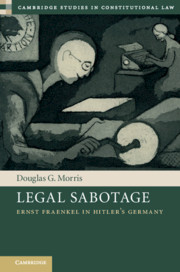
BOOK: Douglas MORRIS, Legal Sabotage. Ernst Fraenkel in Hitler's Germany (Cambridge: CUP, 2020), ISBN 9781108835008, 85 GBP


(image source: CUP)

Abstract:

The Jewish leftist lawyer Ernst Fraenkel was one of twentieth-century Germany's great intellectuals. During the Weimar Republic he was a shrewd constitutional theorist for the Social Democrats and in post-World War II Germany a respected political scientist who worked to secure West Germany's new democracy. This book homes in on the most dramatic years of Fraenkel's life, when he worked within Nazi Germany actively resisting the regime, both publicly and secretly. As a lawyer, he represented political defendants in court. As a dissident, he worked in the underground. As an intellectual, he wrote his most famous work, The Dual State – a classic account of Nazi law and politics. This first detailed account of Fraenkel's career in Nazi Germany opens up a new view on anti-Nazi resistance – its nature, possibilities, and limits. With grit, daring and imagination, Fraenkel fought for freedom against an increasingly repressive regime.
On the author:

Douglas Morris is both a legal historian and a criminal defense attorney for indigent clients in New York City. He has published widely on twentieth-century German legal history and was a recipient of the 1998 Thurgood Marshall Award from the Association of the Bar of the City of New York for serving 'as pro bono counsel to a human being under a sentence of death'.

(read more with CUP

05 August 2020

BOOK: Douglas G. MORRIS, Legal Sabotage : Ernst Fraenkel in Hitler’s Germany (Cambridge: Cambridge University Press, 2020). ISBN 9781108835008, USD 110.00


(Source: CUP)

Cambridge University Press is publishing a book on the Jewish leftist lawyer Ernst Fraenkel.

ABOUT THE BOOK

The Jewish leftist lawyer Ernst Fraenkel was one of twentieth-century Germany's great intellectuals. During the Weimar Republic he was a shrewd constitutional theorist for the Social Democrats and in post-World War II Germany a respected political scientist who worked to secure West Germany's new democracy. This book homes in on the most dramatic years of Fraenkel's life, when he worked within Nazi Germany actively resisting the regime, both publicly and secretly. As a lawyer, he represented political defendants in court. As a dissident, he worked in the underground. As an intellectual, he wrote his most famous work, The Dual State – a classic account of Nazi law and politics. This first detailed account of Fraenkel's career in Nazi Germany opens up a new view on anti-Nazi resistance – its nature, possibilities, and limits. With grit, daring and imagination, Fraenkel fought for freedom against an increasingly repressive regime.

ABOUT THE AUTHOR

Douglas MorrisFederal Defenders of New York

Douglas Morris is both a legal historian and a criminal defense attorney for indigent clients in New York City. He has published widely on twentieth-century German legal history and was a recipient of the 1998 Thurgood Marshall Award from the Association of the Bar of the City of New York for serving 'as pro bono counsel to a human being under a sentence of death'.

TABLE OF CONTENTS

Introduction
1. Setting the scene of a Jewish lawyer, like Fraenkel, in nazi Germany
2. Fraenkel as a social democrat practicing law in nazi Germany
3. Fraenkel as an essayist supporting the illegal underground
4. Fraenkel as a scholar renouncing the nazi regime's dual state
5. Thinking about legal justifications for sabotaging a tyrannical regime
Conclusion. The Ernst Fraenkel dilemma.

More info here

10 June 2020

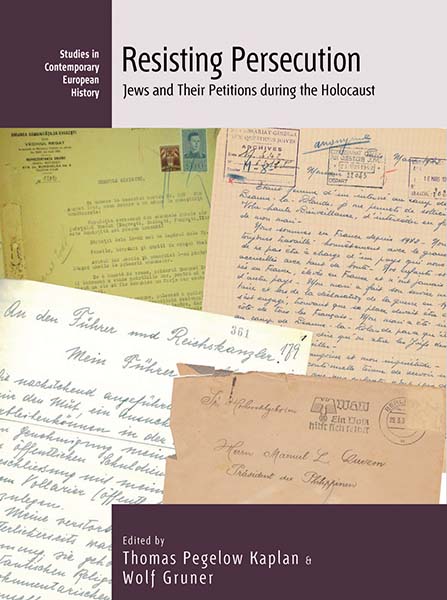
BOOK: Thomas P. KAPLAN and Wolf GRUNER, Eds., Resisting Persecution: Jews and Their Petitions during the Holocaust (New York - Oxford: Berghahn Books, 2020). ISBN 978-1-78920-720-0, $120.00


(Source: Berghahn Books)

Berghahn books is publishing a book on petitions by Jewish people during the Holocaust.

ABOUT THE BOOK

Since antiquity, European Jewish diaspora communities have used formal appeals to secular and religious authorities to secure favors or protection. Such petitioning took on particular significance in modern dictatorships, often as the only tool left for voicing political opposition. During the Holocaust, tens of thousands of European Jews turned to individual and collective petitions in the face of state-sponsored violence. This volume offers the first extensive analysis of petitions authored by Jews in nations ruled by the Nazis and their allies. It demonstrates their underappreciated value as a historical source and reveals the many attempts of European Jews to resist intensifying persecution and actively struggle for survival.

ABOUT THE EDITORS

Thomas Pegelow Kaplan is the Leon Levine Distinguished Professor and Director of the Center for Judaic, Holocaust, and Peace Studies at Appalachian State University. He is the author of The Language of Nazi Genocide (2009) and the co-editor of Beyond ‘Ordinary Men’: Christopher R. Browning and Holocaust Historiography (2019).

Wolf Gruner is the Shapell-Guerin Chair in Jewish Studies, Professor of History and Founding Director of the USC Shoah Foundation Center for Advanced Genocide Research at the University of Southern California. He is the author of nine books on the Holocaust, including Jewish Forced Labor under the Nazis (2006) and the prize-winning The Holocaust in Bohemia and Moravia (English edition 2019, German original 2016).

TABLE OF CONTENTS

List of Illustrations
Acknowledgments
Introduction
Thomas Pegelow Kaplan and Wolf Gruner
Chapter 1. To Not “Live as a Pariah”: Jewish Petitions as Individual and Collective Protest in the Greater German Reich
Wolf Gruner
Chapter 2. “Did We Not Shed Our Blood for France?” Identity and Resistance in Entreaties for the Jewish Internees of Occupied France, 1940–44
Stacy Renee Veeder
Chapter 3. Honorary Czechs and Germans: Petitions for Aryan Status in the Nazi Protectorate of Bohemia and Moravia
Benjamin Frommer
Chapter 4. Legal Resistance through Petitions during the Holocaust: The Strategies of Romanian Jewish Leader Wilhelm Filderman, 1940–44
Stefan C. Ionescu
Chapter 5. Attempts to Take Action In a Coerced Community? Petitions to the Jewish Council in the Lodz Ghetto during World War II
Svenja Bethke
Chapter 6. Petitioning Matters: Jews and Non-Jews Negotiating Ghettoization in Budapest, 1944
Tim Cole
Chapter 7. Global Jewish Petitioning and the Reconsideration of Spatial Analysis in Holocaust Historiography: The Case of Rescue in the Philippines
Thomas Pegelow Kaplan
Chapter 8. Petitioning for “Equal Treatment”: The Struggles of Intermarried Holocaust Survivors in Postwar Germany
Maximilian Strnad
Conclusion
Thomas Pegelow Kaplan and Wolf Gruner
Appendix: European-Jewish Petitions during the Holocaust
Bibliograhpy
Index

More info here

04 June 2020

BOOK: Francine HIRSCH, Soviet Judgment at Nuremberg - A New History of the International Military Tribunal after World War II (Oxford: Oxford University Press, 2020). ISBN 9780199377930, £26.99


(Source: OUP)

OUP is publishing a book offering a Soviet perspective to the Nuremberg trials.

ABOUT THE BOOK

Organized in the immediate aftermath of World War II to try the former Nazi leaders for war crimes, the Nuremberg trials, known as the International Military Tribunal (IMT), paved the way for global conversations about genocide, justice, and human rights that continue to this day. As Francine Hirsch reveals in this immersive new history of the trials, a central piece of the story has been routinely omitted from standard accounts: the critical role that the Soviet Union played in making Nuremberg happen in the first place. Hirschs book reveals how the Soviets shaped the trials—only to be written out of their story as Western allies became bitter Cold War rivals.

Soviet Judgment at Nuremberg offers the first full picture of the war trials, illuminating the many ironies brought to bear as the Soviets did their part to bring the Nazis to justice. Everyone knew that Stalin had originally allied with Hitler before the Nazi invasion of the Soviet Union. The Molotov-Ribbentrop Pact of 1939 hung heavy over the courtroom, as did the suspicion among the Western prosecutors and judges that the Soviets had falsified evidence in an attempt to pin one of their own war crimes, the Katyn massacre of Polish officers, on the Nazis. It did not help that key members of the Soviet delegation, including the Soviet judge and chief prosecutor, had played critical roles in Stalin's infamous show trials of the 1930s. For the lead American prosecutor Robert H. Jackson and his colleagues, Soviet participation in the Nuremberg Trials undermined their overall credibility and possibly even the moral righteousness of the Allied victory.

Yet Soviet jurists had been the first to conceive of a legal framework that treated war as an international crime. Without it, the IMT would have had no basis for judgment. The Soviets had borne the brunt of the fighting against Germany—enduring the horrors of the Nazi occupation and experiencing almost unimaginable human losses and devastation. There would be no denying their place on the tribunal, nor their determination to make the most of it. Once the trials were set in motion, however, little went as the Soviets had planned. Soviet Judgment at Nuremberg shows how Stalin's efforts to direct the Soviet delegation and to steer the trials from afar backfired, and how Soviet war crimes became exposed in open court.

Hirsch's book offers readers both a front-row seat in the courtroom and a behind-the-scenes look at the meetings in which the prosecutors shared secrets and forged alliances. It reveals the shifting relationships among the four countries of the prosecution (the U.S., Great Britain, France, and the USSR), uncovering how and why the Palace of Justice in Nuremberg became a Cold War battleground. In the process Soviet Justice at Nuremberg offers a new understanding of the trials and a fresh perspective on the post-war movement for human rights.

ABOUT THE AUTHOR

Francine Hirsch is Professor of History at the University of Wisconsin-Madison and the author of Empire of Nations.

TABLE OF CONTENTS

Introduction: The Untold Story
Part I: The Road to Nuremberg
Chapter One: When War Became a Crime
Chapter Two: But What Is Justice?
Chapter Three: Countdown to Indictment
Chapter Four: Ready or Not
Part II: The Prosecution's Case
Chapter Five: The Trial Begins
Chapter Six: Stuck on the Sidelines
Chapter Seven: Course Corrections
Chapter Eight: Bearing Witness
Part III: The Defense Case
Chapter Nine: The Cold War Comes to Nuremberg
Chapter Ten: In the Name of a Fair Trial
Chapter Eleven: Accusations and Counter-Accusations
Chapter Twelve: The Katyn Showdown
Part IV: Last Words and Judgments
Chapter Thirteen: Collective Guilt and the Fate of Postwar Europe
Chapter Fourteen: Judgment
Chapter Fifteen: Beyond Nuremberg
Acknowledgements
Endnotes
Research Note
Notes and Sources
Bibliographical Notes and Suggestions for Further Reading
Index

More info here

27 February 2020

CALL FOR PAPERS: Local Administration during the First and Second World Wars (Prague, 2-4 September 2020) (DEADLINE: 17 March 2020)


(Source: Pol-Int)

We learned of a call for papers for a conference in Prague on local administrations during the two world wars. Here the call:

Local administration has always played a key role in securing, implementing and stabilizing the authority of the modern state. After the outbreak of the First World War, the warring countries were confronted with a difficult supply situation, including famine, disease, refugees and labor shortages. The clerks of the local administration were responsible for implementing new policies and solving problems. They were the ones in direct contact with local populations which were often multi-ethnic and presented a broad variety of needs.

In many cases, local administrations were reorganized to deal with vast and unprecedented tasks and problems. In other cases, the German Empire and Austria-Hungary established military occupation administrations which depended on existing local administration, for example in Belgium, Serbia and Ukraine.

Not only military defeat but also the failure of overtaxed local administrations to solve substantial problems such as obtaining sufficient food supplies for the population led to revolts in the German Empire and the Habsburg Monarchy.

This drastic experience prompted Nazi Germany in particular to undertake a reorganization of local administration shortly before the outbreak of the Second World War. Even after large parts of Europe were under German occupation, local administrations remained largely responsible for the daily life needs of local populations, such as organizing production, distribution and rationing of food and other basic goods, such as heating fuel and clothing. Since state food allotments were often insufficient to meet basic needs, local populations reacted with the development of a variety of illegal practices. Farmers evaded compulsory levies of food and sold undocumented, illegally butchered meat. Hidden stores of products, food and ration stamps were traded for other goods as part of a comprehensive black market. Although nominally supervised by German occupiers, the actual prosecution of these new economic crimes generally fell in the responsibility of local administrations and courts. Local courts continued to hear non-political cases and disputes within local populations as well.

Recent research in Holocaust Studies have showed that local administrations not only played an important role in making the mass murder of the European Jews possible, but that it was often local administrations that took the initiative.

This conference aims to bring together scholars who work on specific aspects of local administration in the First World War and the Second World War and analyze and compare a diversity of methodologies, findings and approaches.

We are particularly interested in papers that are dealing with the following historical focuses:

- The relationship between the occupying power and local administration.
- Local administration and the war economy
- Local courts under occupation
- Continuity and change in staffing aspects of local administration under occupation
- Questions of local administration and local interpretation of collaboration

Prof. Jonathan Gumz will give a keynote address on local administration and the First World War.

Prof. Dieter Pohl will give a keynote address on local administration and the Second World War.

At the moment we are able to cover accommodation and parts of the travel costs, we are still looking for funds for travel costs.

The conference language is English.

Please send your abstracts of approximately 500 words by 17 March 2020 to:

(Source: Pol-Int.org)

09 December 2019

CALL FOR APPLICATIONS: Remote Access to the Arolsen Archives from Amsterdam (29-31 January 2020, Amsterdam) (DEADLINE: 16 December 2019)


(Source: Arolsen Archives)

The Arolsen Archives -International Center on Nazi Persecution- has a call for applications for scholars from The Netherlands and surrounding countries to attend a research seminar on access to the digital collections of the archive.

Call for Applications

As part of a broader strategy to enable and improve access to the entire digital collections, the Arolsen Archives and the NIOD Institute for War, Holocaust and Genocide Studies are co-organising an international three-day research seminar for scholars from the Netherlands and neighbouring countries. The event will take place at the NIOD in Amsterdam from 29 January through 31 January 2020. At its core, the seminar will enable participants to carry out their own research in the digital collections of the Arolsen Archives through a recently established “remote access” solution. Competent staff on site will provide guidance in exploring the depths of the digital archive. For this, participants will have to bring along their personal (portable) computers. Please note that remote access will only be possible on devices running Microsoft Windows. Participants will be able to save selected documents of interest free of charge.

Interested candidates from The Netherlands and neighbouring countries are encouraged to send their application via e-mail to requests-rs@arolsen-archives.org. Applications should consist of a short letter of motivation, a brief biographical note, and an overview of the project for which you intend to explore the digital collections of the Arolsen Archives (1-2 pages in total). The deadline for applications is 16 December 2019. Participants will be chosen and notified by 20 December 2019.

The full call can be found here

17 October 2019

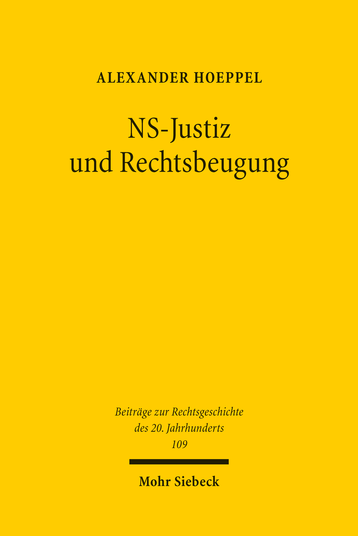
BOOK: Alexander HOEPPEL, NS-Justiz Und Rechtsbeugung : Die Strafrechtliche Ahndung Deutscher Justizverbrechen Nach 1945. (TĂŒbingen: Mohr Siebeck, 2019). ISBN 978-3-16-157022-3, 109.00 EUR


(Source: Mohr Siebeck)

Mohr Siebeck has published a new book on the criminal punishment of German judicial crime after 1945.

ABOUT THE BOOK

In the aftermath of 1945, why were practitioners of law rarely sentenced for the crimes they committed during the Nazi era? Was it because the judges themselves were former Nazi party members or sympathisers? For Alexander Hoeppel, this train of thought does not go far enough: his study reveals that German jurisprudence actually went to the extent of adopting a legal doctrine that shielded judges and other legal professionals from being prosecuted for crimes committed in office – and continues to do so even to this day.

ABOUT THE AUTHOR

Alexander Hoeppel Geboren 1984; Studium der Neueren und Neuesten Geschichte, der Politischen Wissenschaft und der Philosophie; Wissenschaftliche Mitarbeiter am Zentralinstitut fĂŒr Angewandte Ethik und Wissenschaftskommunikation an der Friedrich-Alexander-UniversitĂ€t Erlangen-NĂŒrnberg; Projektleiter des Model United Nations Projektes der UniversitĂ€t Erlangen-NĂŒrnberg (FAUMUN); Lehrbeauftragter fĂŒr Verhandlungslehre ebenda; seit 2017 selbststĂ€ndiger Verhandlungstrainer; 2018 Promotion.

The table of contents can be found here

15 October 2019

BOOK: Dan PORAT, Bitter Reckoning Israel Tries Holocaust Survivors as Nazi Collaborators (Cambridge: Harvard University Press, 2019). ISBN 9780674988149, €27.00


(Source: HUP)

Harvard University Press has published a new book on the kapo trials in Israeli legal history.  

ABOUT THE BOOK

Beginning in 1950, the state of Israel prosecuted and jailed dozens of Holocaust survivors who had served as camp kapos or ghetto police under the Nazis. At last comes the first full account of the kapo trials, based on records newly declassified after forty years.

In December 1945, a Polish-born commuter on a Tel Aviv bus recognized a fellow rider as the former head of a town council the Nazis had established to manage the Jews. When he denounced the man as a collaborator, the rider leapt off the bus, pursued by passengers intent on beating him to death. Five years later, to address ongoing tensions within Holocaust survivor communities, the State of Israel instituted the criminal prosecution of Jews who had served as ghetto administrators or kapos in concentration camps.

Dan Porat brings to light more than three dozen little-known trials, held over the following two decades, of survivors charged with Nazi collaboration. Scouring police investigation files and trial records, he found accounts of Jewish policemen and camp functionaries who harassed, beat, robbed, and even murdered their brethren. But as the trials exposed the tragic experiences of the kapos, over time the courts and the public shifted from seeing them as evil collaborators to victims themselves, and the fervor to prosecute them abated.

Porat shows how these trials changed Israel’s understanding of the Holocaust and explores how the suppression of the trial records—long classified by the state—affected history and memory. Sensitive to the devastating options confronting those who chose to collaborate, yet rigorous in its analysis, Bitter Reckoning invites us to rethink our ideas of complicity and justice and to consider what it means to be a victim in extraordinary circumstances.

ABOUT THE AUTHOR

Dan Porat is the author of The Boy: A Holocaust Story, which the New York Times called “a gripping, harrowing Holocaust story” and Elie Wiesel praised as “a poignant and riveting investigation.” Porat is a teacher and researcher at The Hebrew University of Jerusalem.

TABLE OF CONTENTS

Introduction
1. From Revenge to Retribution in Post-Nazi Europe
2. Tensions among Survivors in Mandatory Palestine
3. The Nazis and Nazi Collaborators Punishment Law
4. Preliminary Court Examinations
5. Weighing the Actions of Jewish Collaborators
6. Can a Jewish Kapo Commit a Crime against Humanity?
7. The First Doubts about the Kapo Trials
8. Judging a Nazi and Reframing Collaboration
9. Absolving Ordinary Functionaries
Epilogue
Notes
Acknowledgments
Illustration Credits
Index

More info here

BOOK: Rande W. KOSTAL, Laying Down the Law : The American Legal Revolutions in Occupied Germany and Japan (Cambridge: Harvard University Press, 2019). ISBN 9780674052413, €49.50


(Source: HUP)

Harvard University Press has published a new book on the legal transformation of Occupied Japan and Germany.

ABOUT THE BOOK

A legal historian opens a window on the monumental postwar effort to remake fascist Germany and Japan into liberal rule-of-law nations, shedding new light on the limits of America’s ability to impose democracy on defeated countries.

Following victory in World War II, American leaders devised an extraordinarily bold policy for the occupations of Nazi Germany and imperial Japan: to achieve their permanent demilitarization by compelled democratization. A quintessentially American feature of this policy was the replacement of fascist legal orders with liberal rule-of-law regimes.

In his comparative investigation of these epic reform projects, noted legal historian R. W. Kostal shows that Americans found it easier to initiate the reconstruction of foreign legal orders than to complete the process. While American agencies made significant inroads in the elimination of fascist public law in Germany and Japan, they were markedly less successful in generating allegiance to liberal legal ideas and institutions.

Drawing on rich archival sources, Kostal probes how legal-reconstructive successes were impeded by German and Japanese resistance on one side, and by the glaring deficiencies of American theory, planning, and administration on the other. Kostal argues that the manifest failings of America’s own rule-of-law democracy weakened U.S. credibility and resolve in bringing liberal democracy to occupied Germany and Japan.

In Laying Down the Law, Kostal tells a dramatic story of the United States as an ambiguous force for moral authority in the Cold War international system, making a major contribution to American and global history of the rule of law.

ABOUT THE AUTHOR

R. W. Kostal is Professor in the Faculty of Law at Western University, Ontario, and author of Law and English Railway Capitalism, 1825–1875, and A Jurisprudence of Power: Victorian Empire and the Rule of Law.

TABLE OF CONTENTS

Introduction: Laying Down the Law in Occupied Germany and Japan
1. The “Destruction of Philosophies”: Planning the Legal Reconstruction of Germany and Japan
2. Occupying the Legal Other: The Subjugation of the German and Japanese Legal Systems
3. Captive Constitutions: Remaking Constitutional Law in Occupied Germany and Japan
4. Crafting Liberal Courts: Reconstituting the German and Japanese Judiciaries
5. Clearing the Spiritual Rubble: Reforming Criminal Justice in Occupied Germany and Japan
6. Twilight of the Gods: The Rise and Fall of Civil Liberties in Occupied Germany and Japan
Conclusion: Laying Down the Law: Americans as Legal Revolutionaries
Abbreviations
Notes
Acknowledgments
Index

More information here

14 October 2019

BOOK: Hans Petter GRAVER (Melanie HACK Transl.), Der Krieg der Richter Die Deutsche Besetzung 1940-1945 und der norwegische Rechtsstaat,. (Baden-Baden: Nomos , 2019). ISBN 978-3-8487-5475-5, €84.00


(Source: Nomos)

Nomos has published a new book (translated to German from Norwegian) on the German and Norwegian courts during the time of Nazi occupation.

ABOUT THE BOOK

Hans Petter Graver, Seines Zeichens Ordinarius am Institut fĂŒr Privatrecht der UniversitĂ€t Oslo, arbeitet in seinem Buch „Richter im Krieg“ die Rolle der deutschen und norwegischen Gerichte wĂ€hrend der Besatzungszeit von 1940 bis 1945 auf. „Furchtbare Juristen“ verrichteten wĂ€hrend des Zweiten Weltkriegs auch in Norwegen ihren „Dienst“, allen voran jene des Reichskriegsgerichts, des SS- und Polizeigerichts Nord sowie diverser Sondertribunale und Standgerichte. WĂ€hrend die Nazifizierung nicht zuletzt durch den Nasjonal Samling fast das gesamte Rechtswesen erfasste, gab es auch Protest in der Richterschaft. Wie ist jedoch der relativ geringe Widerstand zu erklĂ€ren? Wie ließen sich „nationalsozialistischer Geist“ mit richterlichem SelbstverstĂ€ndnis und professionellem Berufsethos vereinbaren? Hans Petter Graver gibt nun auch fĂŒr die Leserschaft im deutschsprachigen Raum einen spannenden Einblick in eine Zeit voller Gewissensfragen.

More info here

24 September 2019

BOOK: Marc BERGÈRE, Jonas CAMPION, Emmanuel DROIT, Dominik RIGOLL & Marie-Bénédicte VINCENT (dir.), Pour une histoire connectée et transnationale des épurations en Europe aprÚs 1945 [Convergences] (Bruxelles: PIE Peter Lang, 2019), 400 p., ISBN 978-2-8076-0689-0

(image source: Peter Lang)

On the authors:
Marc BergĂšre, Professeur en histoire contemporaine Ă  l’universitĂ© Rennes 2/EA Tempora 7468, est spĂ©cialiste de l’histoire de l’Ă©puration en France. Jonas Campion est Docteur en histoire (UCLouvain, U. Sorbonne – Paris IV), actuellement ATER Ă  l’U. Lille (Irhis, UMR CNRS 8529) et chercheur associĂ© au Centre d’histoire du droit et de la justice (UCLouvain).
More information with the publisher.

23 January 2019

BOOK: Daniel STAHL, Hunt for Nazis : South America’s Dictatorships and the Prosecution of Nazi Crimes (Amsterdam: Amsterdam University Press, 2018). ISBN 9789462985216, €104.99


Amsterdam University Press has published a book on the prosecution of Nazis having fled to Latin America post World War II (English translation of the 2013 version in German).

ABOUT THE BOOK

Hunt for Nazis is the first comprehensive account of the post-1945 efforts to bring Nazi war criminals who had escaped to South America to justice. The author shows that the Nazi hunt -- which resulted in spectacular cases like the kidnapping of Adolf Eichmann -- should not only be understood as part of the afterlife of the Third Reich, but that it also became an integral aspect of dealing with repression at the hands of authoritarian regimes in South America. Dissidents and human rights activists assumed that the escaped Nazi perpetrators and collaborators continued to be involved in violent crimes in the service of these new dictatorships.

ABOUT THE AUTHOR

Daniel Stahl is Research Associate at the Friedrich Schiller University Jena. For the German publication of Hunt for Nazis Daniel Stahl received the Opus Primum award of the Volkswagen Foundation, Germany's largest private research funder.

More information here

17 October 2018

BOOK: Jean-Paul JEAN, ed., Juger sous vichy, juger vichy (Paris: Librairie LGDJ, 2018). ISBN 978-2-11-145692-1, € 19.00


(Source: Librairie LGDJ)

Librairie LGDJ has published a new book on magistrates during and after Vichy France.

ABOUT THE BOOK

Juger sous Vichy, puis juger Ă  la LibĂ©ration. Servir l’Etat français et le MarĂ©chal PĂ©tain auquel ils ont prĂȘtĂ© serment de fidĂ©litĂ©, puis juger dans la France libĂ©rĂ©e et prĂ©sider les juridictions de l’Epuration. Ces parcours de magistrats sous Vichy comme Ă  la LibĂ©ration montrent la complexitĂ© des situations et des comportements qui doivent ĂȘtre toujours remis dans leur contexte. La finalitĂ© de cet ouvrage est de rassembler des contributions documentĂ©es qui permettent de mettre en perspective l’historiographie et les travaux de recherche qui apportent, avec l’ouverture des archives, toujours des Ă©lĂ©ments nouveaux alors que les derniers tĂ©moins disparaissent. Ces textes sont d’abord destinĂ©s aux jeunes juristes, aux magistrats et avocats pour les aider Ă  rĂ©flĂ©chir, en conscience, sur leurs mĂ©tiers et les consĂ©quences de leurs attitudes et de leurs dĂ©cisions, leurs choix Ă©thiques et leurs responsabilitĂ©s en situation de crise mais aussi dans leur travail quotidien, Ă  chaque fois qu’une libertĂ© est en jeu.

TABLE OF CONTENTS

Introduction
Juger sous Vichy et Ă  la LibĂ©ration, par Jean-Paul Jean, PrĂ©sident de chambre Ă  la Cour de cassation, vice-prĂ©sident de l’AFHJ
RepĂšres chronologiques
PARTIE 1. JUGER SOUS VICHY (1940-1944)
CHAPITRE 1. Juridictions de Vichy
  • Le masque de la loi sous Vichy, Denis Salas
  • Une exception ordinaire. Les magistrats et les juridictions d’exception de Vichy, Alain Bancaud
  • Le barreau de Paris pendant la Seconde Guerre mondiale (1940-1945), Yves Ozanam
  • Maurice Garçon, avocat, Ă©crivian,  Jean-Paul Jean
  • La section lyonnaise du tribunal d’État et la Section spĂ©ciale prĂšs la cour d’appel de Lyon : l’exemplaritĂ© Ă  l’Ă©preuve des faits, Catherine Fillon
  • La Milice et les cours martiales. La cour martiale de Lyon, 2 fĂ©vrier-4 aoĂ»t 1944, Laurent Douzou, Virginie Sansico
  • La Section spĂ©ciale de Dijon, Jean-Louis Halperin
  • L’exception et l’exemple, Marc-Olivier Baruch
CHAPITRE 2. Acteurs de la Collaboration et de la Résistance
  • LĂ©opold Rabinovtich, rĂ©sistant juif traduit devant la Section spĂ©ciale de Lyon, TĂ©moignage prĂ©sentĂ© par Catherine Fillon
  • RenĂ© Linais, juge Ă  la section spĂ©ciale, Pierre Truche, Denis Salas
  • Le jugement des juges des sections spĂ©ciales et le « principe sacrĂ© » du secret du dĂ©libĂ©rĂ©,Alain Bancaud, Jean-Paul Jean
  • Les milieux judiciaires dans la RĂ©sistance et Ă  la LibĂ©ration, Liora IsraĂ«l
  • De Vichy Ă  la RĂ©sistance : le bĂątonnier Jacques Charpentier, Yves Ozanam
  • RenĂ© Parodi, le martyr de la rĂ©sistance judiciaire, Jean-Paul Jean
  • Quel regard porter sur les magistrats ayant siĂ©gĂ© dans les juridictions d’exception sous l’Occupation ?,Jean-Paul Jean
PARTIE 2. JUGER VICHY (1944-1946)
CHAPITRE 1. Juridictions de l'Epuration
  • Avant la LibĂ©ration : la politique de la Justice Ă  Alger et le procĂšs Pucheu (1943-1944), Jean-Louis CrĂ©mieux-Brilhac
  • La transition dĂ©mocratique française aprĂšs la Seconde Guerre mondiale, Denis Salas : Le procĂšs de Robert Brasillach (cour de justice de la Seine, 19 janvier 1945, 13 heures) ; Le procĂšs du marĂ©chal PĂ©tain (Haute Cour, palais de justice, 23 juillet-15 aoĂ»t 1945)
  • L'Ă©puration judiciaire Ă  la LibĂ©ration : entre lĂ©galitĂ© et exception, Alain Bancaud
  • La cour martiale de l'IsĂšre (30 aoĂ»t-6 octobre 1944), Tal Bruttmann, Claire Courtecuisse
  • Rendre une justice politique : l'exemple des chambres civiques de la Seine (1945-1951), Anne Simonin
  • La Cour de justice de Lyon, section du RhĂŽne (septembre 1944-juillet 1949), Virginie Sansico
  • Le procĂšs de Charles Maurras (24-27 janvier 1945), Catherine Fillon
CHAPITRE 2. Acteurs de l'Epuration
  • Histoire d'une conversion : les magistrats rĂ©sistants aprĂšs la LibĂ©ration au service de la rĂ©affirmation de la nouvelle raison d'Etat, Alain Bancaud
  • François de Menthon, le garde des Sceaux oubliĂ© (4 septembre 1943-30 mai 1945), Paul Dreyfus
  • Joseph, dit JoĂ« Nordmann (1910-2005), Liora IsraĂ«l
  • La figure de Maurice Patin, Directeur des Affaires criminelles et des grĂąces (24 aoĂ»t 1944-1er aout 1946), Sylvie Humbert
  • Maurice Rolland et l'Inspection des services judiciaires Ă  la LibĂ©ration, Jean-Paul Jean
  • Un jour de septembre 1944, Maurice Dumolard
  • « Le droit romain n'est plus ». Note sur un conte Ă©crit par Aragon en 1944, Daniel Bougnoux,
Note relative Ă  l’origine des textes du prĂ©sent volume
RepĂšres bibliographiques, Jean-Paul Jean
Varia
  • DĂ©linquance en temps de crise. « L’ordinaire exceptionnel » devant la justice correctionnelle des Alpes-Maritimes (1938-1944), Riadh Ben Khalifa
  • L’oubli ou la garantie d’ĂȘtre, Cathy Leblanc
Résumés / Abstracts
Notes de lecture

More information here

03 October 2018

BOOK: Mary FULBROOK, Reckonings - Legacies of Nazi Persecution and the Quest for Justice. (Oxford: Oxford University Press, 2018). ISBN 9780190681241, $34.95


(Source: OUP)

Oxford University Press is publishing a new book on the legacy of Nazi persecutions.

ABOUT THE BOOK

A single word--"Auschwitz"--is sometimes used to encapsulate the totality of persecution and suffering involved in what we call the Holocaust. Yet focusing on a single concentration camp, however horrific the scale of crimes committed there, leaves an incomplete story, truncates a complex history and obscures the continuing legacies of Nazi crimes.

Mary Fulbrook's encompassing book explores the lives of individuals across a full spectrum of suffering and guilt, each one capturing one small part of the greater story. Using "reckoning" in the widest possible sense to evoke how the consequences of violence have expanded almost infinitely through time, from early brutality through programs to euthanize the sick and infirm in the 1930s to the full functioning of the death camps in the early 1940s, and across the post-war decades of selective confrontation with perpetrators and ever-expanding commemoration of victims, Fulbrook exposes the disjuncture between official myths about "dealing with the past" and the extent to which the vast majority of Nazi perpetrators evaded responsibility. In the successor states to the Third Reich -- East Germany, West Germany, and Austria -- prosecution varied widely. Communist East Germany pursued Nazi criminals and handed down severe sentences; West Germany, caught between facing up to the past and seeking to draw a line under it, tended toward selective justice and reintegration of former Nazis; and Austria made nearly no reckoning at all until the mid-1980s, when news broke about Austrian presidential candidate Kurt Waldheim's past. The continuing battle with the legacies of Nazism in the private sphere was often at odds with public remembrance and memorials. 

Following the various phases of trials and testimonies, from those immediately after the war to those that stretched into the decades following, Reckonings illuminates shifting public attitudes toward both perpetrators and survivors, and recalibrates anew the scales of justice.

ABOUT THE AUTHOR

Mary Fulbrook is Professor of German History at University College London and the author of the Fraenkel Prize-winning A Small Town near Auschwitz: Ordinary Nazis and the Holocaust.

TABLE OF CONTENTS

Preface
Acknowledgments

1. The Significance of the Nazi Past

Part One Chasms: Patterns of Persecution 
2. The Explosion of State-Sponsored Violence
3. Institutionalised Murder
4. Microcosms of Violence: Polish Prisms
5. Endpoints: The Machinery of Extermination
6. Defining Experiences
7. Silence and Communication

Part Two Confrontations: Landscapes of the Law
8. Transitional Justice
9. Judging Their Own: Selective Justice in the Successor States
10. From Euthanasia to Genocide
11. Major Concentration Camp Trials: Auschwitz and Beyond
12. The Diffraction of Guilt
13. Late, Too Late

Part Three Connections: Memories and Explorations 
14. Hearing the Voices of Victims
15. Making Sense of the Past, Living for the Present
16. Discomfort Zones
17. The Sins of the Fathers
18. The Long Shadows of Persecution
19. Oblivion and Memorialisation

Conclusions:
20. A Resonant Past

More information here

21 September 2018

BOOK: David COHEN and Yuma TOTANI, The Tokyo War Crimes Tribunal - Law, History, and Jurisprudence (Cambridge: Cambridge University Press, 2018). ISBN 9781107119703, £ 105.00


Cambridge University Press is publishing a new book on the Tokyo War Crimes Tribunal next month.

ABOUT THE BOOK

Like its Nuremberg counterpart, the Tokyo trial was foundational in the field of international law. However, up to now, the persistent notion of 'victor's justice' in the existing historical literature has made it difficult to treat it as such. David Cohen and Yuma Totani seek to redress this by cutting through persistent orthodoxies and ideologies that have plagued the trial. Instead they present it simply as a judicial process, and in so doing reveal its enduring importance for international jurisprudence. A wide range of primary sources are considered, including court transcripts, court exhibits, the majority judgment, and five separate concurring and dissenting opinions. The authors also provide comparative analysis of the Allied trials at Nuremberg, resulting in a comprehensive and empirically grounded study of the trial. The Tokyo tribunal was a watershed moment in the history of the Asia-Pacific region. This ground breaking study reveals it is of continuing relevance today.

ABOUT THE AUTHORS

David CohenStanford University, California

David Cohen directs the WSD Handa Center for Human Rights and International Justice at Stanford University. Previously Cohen was at the War Crimes Studies Center at the University of California, Berkeley, where he taught for thirty-five years before moving the Center to Stanford University in 2013. He publishes on international criminal law, transitional justice, human rights, classics, and comparative legal history, while also directing human rights, rule of law, and accountability projects in South and Southeast Asia and Africa.
Yuma TotaniUniversity of Hawaii

Yuma Totani is a historian of modern Japan and presently teaches at the University of Hawaii. Her research interests are in World War II and war crimes trials in Asia and the Pacific. She is the author of The Tokyo War Crimes Trial (2008) and Justice in Asia and the Pacific Region, 1945–1952 (Cambridge, 2015). She has received various fellowships, including a National Fellowship from the Hoover Institution (2016), the Frederick Burkhardt Residential Fellowship (2012), and the Abe Fellowship (2011).

TABLE OF CONTENTS

Introduction
Part I. The Allied War Crimes Policy, the Indictment, and Court Proceedings:
1. The framework of the trial
2. Charges of crimes against peace
3. The Japanese system of government
4. Individual roles in the making of the war and the overall conspiracy
5. Counts on murder, conventional war crimes, and crimes against humanity
6. Accountability of war crimes
Part II. Law and Jurisprudence of the Judgments and Separate Opinions:
7. The majority judgment: crimes against peace
8. An alternative perspective on accountability for crimes against peace: the two Webb judgments
9. The majority judgment on war crimes
10. An alternative Tokyo judgment: the draft Webb judgment on war crimes
11. The dissenting opinions by Justices Bernard and Roeling
12. Pal's 'judgment', or dissenting opinion, on crimes against peace
13. Pal's treatment of war crimes charges
14. The concurring opinions of Justices Webb and Jaranilla
Conclusion.

More information here

10 August 2018

BOOK: Mathew TURNER, Historians at the Frankfurt Auschwitz Trial (London: I.B. Tauris, 2018). ISBN 9781788310734, € 79,21


I.B. Tauris is publishing a book on the role of historians as expert witnesses during the Frankfurt Auschwitz Trial.

ABOUT THE BOOK

The Frankfurt Auschwitz trial was a milestone event in West German history. Between 1963 and 1965, twenty-two former Auschwitz personnel were tried in Frankfurt am Main. It was a trial that saw the engagement of four of the nation's leading historians as expert witnesses - Martin Broszat, Hans Buchheim, Helmut Krausnick, and Hans-Adolf Jacobsen - appointed by the prosecution to give evidence pertaining to the historical and organisational context of the Holocaust. Following the trial, the reports of these historians were published in a bestselling book, Anatomie des SS-Staates (Anatomy of the SS State) and Mathew Turner here investigates the relationship between the trial and this publication. In recent years, more attention has been paid to the intersection between history and law that accompanies historians' entry into the courtroom. Very little, however, has been written about this intersection with a focus on a single case study. Based on original research in several German archives and first-hand interviews, Turner addresses these connections through a study of West Germany's most famous trial, and the monumental work of history produced from the engagement of historical expertise in court.

ABOUT THE AUTHOR

Mathew Turner is a Lecturer in History at Deakin University, Australia, from where he gained his PhD. He has been a Guest Scholar at the Jena Center for Twentieth Century History in Germany.

TABLE OF CONTENTS

Introduction.
Background to Frankfurt: the IfZ, Gutachten and the Ulm Trial
The Law Courts History: Pre-Trial Preparations
Giving Evidence: The Historians' Court? Or Historians Caught?
Judgement Day: Hofmeyer Reaches a Verdict
Publishing Anatomie: Gutachten to Chapters
Responding to Anatomie: Scholar React
Receiving Anatomie: Hoe the Book Made History
Conclusion
Bibliography

More information here