Search

Showing posts with label socialism. Show all posts

10 July 2026

BOOK: Patrick CHARLOT, Nathalie DROIN, Delphine ESPGNO-ABADIE & Anne-Sophie CHAMBOST (dir.), Le socialisme par le droit (fin XIXe-début XXe siècle) [Contextes. Culture du droit, ed. Anne-Sophie CHAMBOST] (Paris: La Mémoire du Droit, 2026), € 47


(image source: MDD)

Abstract:

Comment « abolir la misère par une réforme du droit » ? Cette définition surprenante du socialisme, proposée en 1897 par Charles Andler, ouvre sur une voie méconnue de la pensée sociale : le socialisme juridique. Loin des révolutions violentes et des transformations économiques radicales, ce courant intellectuel mise sur l’État et ses instruments juridiques pour parvenir à la justice sociale. Cet ouvrage collectif explore un moment charnière de l’histoire des idées, ces « années électriques » du tournant du XXe siècle où socialistes et juristes français découvrent, souvent à travers l’œuvre d’Anton Menger, que le droit peut devenir un levier de transformation sociale. Des balbutiements avec les jugements du « bon juge » Magnaud et les travaux de la première Internationale socialiste, aux vives réactions suscitées par cette approche réformiste, jusqu’à l’examen de sa postérité, l’enquête révèle une richesse théorique largement oubliée. Réunissant historiens du droit et spécialistes de la pensée socialiste, cette recherche collective restitue un pan méconnu de la culture intellectuelle française et interroge la capacité du droit à porter un projet de société. Elle éclaire d’un jour nouveau les débats contemporains sur le rôle de l’État social et la portée transformatrice des normes juridiques.

Read more here

17 April 2026

BOOK REVIEW: Marek Jan WASIŃSKI on Socialism and international law: the cold war and its legacies, edited by Raluca Grosescu and Ned Richardson-Little (Comparative Legal History, XIII (2025), nr. 2 (December), pp. 356-362)

(Image source: Taylor&Francis)

The prevailing scholarly understanding of geopolitical agency in the formation of international law still seems to echo the logic of Hegelian historiography. A benchmark for this narrative was set in 1824 by Leopold von Ranke, who claimed that the Slavic and Byzantine-Islamic East did not belong to the West. Its peoples, he famously wrote, never exercised any independent influence; they only appear either subservient or antagonistic. With Western Europe proclaimed l’Europe européenne, the line drawn around this central and privileged position came to define the civilised and capitalist West in opposition to its politically, economically, and culturally inferior Other. This entity was presumed incapable of theorising or structurally and normatively shaping the international legal order. European international lawyers from beyond the borders of the Latino-Germanic West often feel compelled to perform rhetorical autos-da-fé as acts of symbolic self-sacrifice and purification, in which their own perspectives are disavowed in order to align with a civilisational script authored elsewhere and promising progress and emancipation. Part of this gesture involves the complete substitution of Europe’s inherited geopolitical divisions with alignments based on epistemic, ethical, and ideo-political affinities. This kind of positioning tends to arise within discursive contexts that assert continuity with a Western tradition, often framing local perspectives as having never departed from its presumed universality. However, this may amount to the epistemic self-erasure of what Hans-Georg Gadamer called one’s own horizon of a historically and spatially situated vantage point, continually reshaped by shifting existential conditions. This seemingly subliminal act of repression manifests in the unsettling and paradoxical practice of writing about international law from a Central and Eastern European perspective offering only the faintest articulation of its contextual standpoint. Marxist-informed critiques of international law might read this not as a neutral scholarly gesture, but as a submission to inherited historical conditions, what Marx described as making history not as they please, but under circumstances already passed down. 

To read the full review, please click here. Online access is free for members of the European Society for Comparative Legal History. For further information about the volume on our blog, please visit here.

DOI: 10.1080/2049677X.2025.2580115


09 March 2026

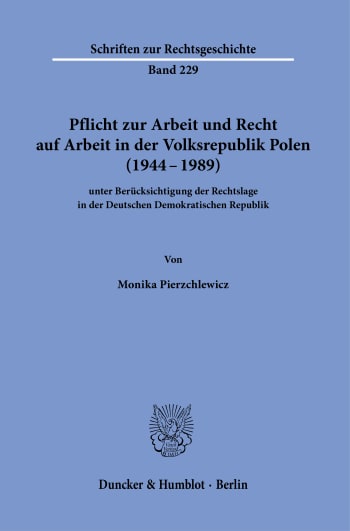
BOOK: Monika PIERZCHLEWICZ, Pflicht zur Arbeit und Recht auf Arbeit in der Volksrepublik Polen (1944-1989) [Schriften zur Rechtsgeschichte; 229] (Berlin: Duncker & Humblot, 2025), 372 p., ISBN 978-3-428-19472-8

Cover: Pflicht zur Arbeit und Recht auf Arbeit in der Volksrepublik Polen (1944–1989)

ABOUT THE BOOK:
 
Die Dissertation untersucht die Arbeitspflicht und das Recht auf Arbeit im sozialistischen Polen und nimmt Bezug auf die Rechtslage in der DDR. Im Sozialismus galt Arbeit als Recht, Pflicht und Ehrensache eines jeden Bürgers, was in den Verfassungen beider Länder verankert war. Neben Verfassungsbestimmungen analysiert die Arbeit Rechtsakte des einfachen Rechts, die strafrechtliche und administrative Sanktionen für die Nichterfüllung der Arbeitspflicht vorsahen. Die Untersuchung zeigt, dass die sozialistische Idealvorstellung von Arbeit als Lebensbedürfnis des Werktätigen und Sache der Ehre, das Ideal der nach sozialistischem Verständnis freiwillig nachgegangenen Pflicht zur Arbeit sowie des Rechts auf eine »ausbeutungsfreie« und »schöpferische« Arbeit in der Realität scheiterten. Die Arbeitspflicht sollte primär wirtschaftlichen Zielen dienen, wobei Zwang im Sozialismus als Mittel zur Erreichung von Freiheit betrachtet wurde.
 
TABLE OF CONTENT:
 
Einleitung
Zum Thema der Arbeit – Forschungsstand – Methodik und Leitfragen – Quellen – Thematischer und zeitlicher Rahmen der Arbeit – Aufbau

1. Einführende Bemerkungen und Begriffserklärungen
Zwangsbegriff – Sozialistischer Freiheitsbegriff – Sozialistischer Staat – Sozialistisches Recht – Wirtschaftliche und politische Hintergründe in der Volksrepublik Polen – Das gesellschaftlich-politische System der DDR und ökonomische Rahmenbedingungen

2. Arbeit im Sozialismus
Arbeitsbegriff – Sozialistische Arbeitsmoral – Sozialistische Berufsfreiheit

3. Pflicht zur Arbeit und Recht auf Arbeit auf Verfassungsebene
Charakter der VRP-Verfassung – Sozialistische Grundrechtskonzeption – Recht auf Arbeit auf Verfassungsebene – Pflicht zur Arbeit auf Verfassungsebene – Das Prinzip der »Einheit von Rechten und Pflichten«

4. Pflicht zur Arbeit und Recht auf Arbeit auf Gesetzesebene
Wiederaufbau des Staates nach dem Zweiten Weltkrieg – Absolventenlenkung – Die Bekämpfung des sog. »sozialen Parasitismus« – Pflicht zur Arbeit in dem Dekret vom 12. Dezember 1981 über das Kriegsrecht (Kriegsrechtsdekret) – Schlussbetrachtung: Recht oder Pflicht?
 
Find more here


10 January 2025

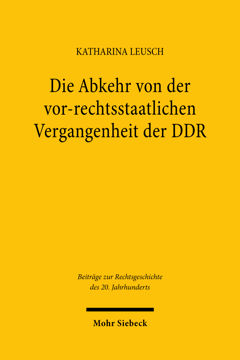
BOOK: Katharina LEUSCH, Die Abkehr von der vor-rechtsstaatlichen Vergangenheit der DDR [Beiträge zur Rechtsgeschichte des 20. Jahrhunderts; 128] (Tübingen: Mohr Siebeck, 2024), 350 p., ISBN 978-3-16-163975-3

 
 Cover von 'undefined'
 
ABOUT THE BOOK:
 
Katharina Leusch untersucht die Phase zwischen der Streichung der Monopolstellung der SED aus der Verfassung der DDR und der ersten freien Volkskammerwahl am 18. März 1990. Gestützt auf die Transitionstheorie der vergleichenden Politikwissenschaft geht sie auf die Tätigkeit des Zentralen Runden Tisches sowie das in dieser Phase entstandene Recht näher ein. Die Volkskammerwahl, sollte sie demokratisch ablaufen, verlangte bestimmte normative Regelwerke wie etwa ein Parteiengesetz (PartG-DDR). Die Autorin verfolgt die Spuren dieses Gesetzes anhand der §§ 20a und 20b PartG-DDR, auch nach der Wiedervereinigung. Diese beiden Normen stellten die Rechtsgrundlage für die Einsetzung der Unabhängigen Kommission zur Überprüfung des Vermögens der Parteien und Massenorganisationen der DDR dar. Durch eine umfassende Archivrecherche wird erstmals die sechzehn Jahre andauernde Kommissionstätigkeit untersucht und gezeigt, wie das Vermögen der Parteien und Massenorganisationen ermittelt und sichergestellt wurde.
 
TABLE OF CONTENTS:
 
Einleitung
Erster Teil - Allgemeine Grundlagen: Das sozialistische Recht und das sozialistische Mehrparteiensystem der DDR
Kapitel 1: Das sozialistische Recht und das Rechtsverständnis der DDR
Kapitel 2: Das sozialistische Mehrparteiensystem und die wesentlichen Akteure dieses Systems

Zweiter Teil - Das Parteiengesetz der DDR: Genese und Inhalt des ersten Parteiengesetzes in der Geschichte der DDR
Kapitel 1: Der Zentrale Runde Tisch als Gesetzgebungsorgan der friedlichen Revolution
Kapitel 2: Die Entwürfe des PartG-DDR
Kapitel 3: Die parteienrechtlichen Regelungen der DDR - ein Ausschnitt
Kapitel 4: Das PartG-DDR als Transitionsrecht

Dritter Teil - Die Unabhängige Kommission zur Überprüfung des Vermögens der Parteien und Massenorganisationen der DDR
Kapitel 1: Die rechtlichen Grundlagen der Unabhängigen Kommission
Kapitel 2: Aufbau und Tätigkeit der Unabhängigen Kommission vor und nach der Wiedervereinigung
Kapitel 3: In- und Auslandsermittlungen
Kapitel 4: Gerichtsverfahren
Kapitel 5: Die Auflösung der Unabhängigen Kommission

Schlussbetrachtungen
 
Find more here

19 December 2024

BOOK: Raluca GROSESCU & Ned RICHARDSON-LITTLE (eds.), Socialism and International Law. The Cold War and Its Legacies [The History and Theory of International Law, eds. Nehal BHUTA, Francesca IURLARO, Anthony PAGDEN & Benjamin STRAUMANN] (Oxford: OUP, 2024), 288 p. ISBN 9780198920175, GBP 100


(image source: OUP)

Abstract:

The contributions of socialist thinkers and states to the development of international law often go unrecognized. Socialism and International Law: The Cold War and Its Legacies explores how socialist individuals and governments from Eastern Europe, Africa, and Asia made vital contributions to international law as it is practiced today, and also brought ideas and initiatives that constituted important disruptive moments in its history. The socialist world of the 20th century was an ambiguous and fragile construct: there were clear divisions between the Soviet-led Eastern Bloc, which kept one foot in Western Eurocentric traditions, and the positions of the radical Third World, primarily post-colonial Afro-Asian states, which mounted a more fundamental challenge to the international order. Far from a monolith, the socialist world was an intricate and dynamic space, which still had many shared common understandings of global affairs and the meaning of the law within them. By examining how different state socialist ideologies, legal principles, and realpolitik affected contemporary international law frameworks, this book contests existing linear and Western-dominated histories. It considers these state socialist engagements in conversation with liberal and Western approaches and underlines the divisions that existed between versions of socialism from different regions and across the North-South divide. The legacies of socialist international law are still with us today, as are the consequences of its failure. With a focus on the Cold War and its aftermath, Socialist International Law features astute commentary on the history and present-day effects of socialist principles applied to international law, provided by an esteemed and diverse group of contributors from around the world.

 Table of contents:

1:Socialism and International Law: Legacies of Innovation, Contradiction, and Failure, Raluca Grosescu and Ned Richardson-Little
2:A Socialist Legal Universalism? Cold War Struggles Over International Law, Sebastian Gehrig
3:Socialism and Self-Determination: Lenin, International Law, and National Liberation, Brad Simpson
4:Soviet Lawyers and Concepts of Aggression in International Law, Michelle Penn
5:Decentring Marxism: The Poznań School and Socialist International Law in Eastern Europe after 1945, Jakub Szumski
6:How China Came to Embrace International Institutions, Ryan Martínez Mitchell
7:Health as a Human Right and Eastern European Anticolonialism, Bogdan C. Iacob
8:Protecting Culture Through International Law in the Postwar World, Nelly Bekus
9:Socialist Internationalism and Decolonizing Moralities in the UN Anti-Trafficking Regime, 1947-54, Sonja Dolinsek and Philippa Hetherington
10:State Socialist Contributions to the Criminalization of Apartheid, Raluca Grosescu
11:Terrorists, Revolutionaries, and Migrants: Cold War Conflicts and Convergences over International Air Hijacking Law, Ned Richardson-Little
12:Socialisms and International Law: Epilogue, Paul Betts

Read more here

11 December 2020

BOOK: Ville ERKKILÄ & Hans-Peter HAFERKAMP, Socialism and Legal History The Histories and Historians of Law in Socialist East Central Europe (London: Routledge, 2020). ISBN 9780367414757, pp. 204, £96.00


(Source: Routledge)

ABOUT THE BOOK

This book focuses on the way in which legal historians and legal scientists used the past to legitimize, challenge, explain and familiarize the socialist legal orders, which were backed by dictatorial governments.  The volume studies legal historians and legal histories written in Eastern European countries during the socialist era after the Second World War. The book investigates whether there was a unified form of socialist legal historiography, and if so, what can be said of its common features. The individual chapters of this volume concentrate on the regimes that situate between the Russian, and later Soviet, legal culture and the area covered by the German Civil Code. Hence, the geographical focus of the book is on East Germany, Russia, the Baltic states, Poland and Hungary. The approach is transnational, focusing on the interaction and intertwinement of the then hegemonic communist ideology and the ideas of law and justice, as they appeared in the writings of legal historians of the socialist legal orders. Such an angle enables concentration on the dynamics between politics and law as well as identities and legal history. Studying the socialist interpretations of legal history reveals the ways in which the 20th century legal scholars, situated between legal renewal and political guidance gave legitimacy to, struggled to come to terms with, and sketched the future of the socialist legal orders. The book will be a valuable resource for academics and researchers working in the areas of Legal History, Jurisprudence and Philosophy of Law and European Studies.


ABOUT THE EDITORS

Ville Erkkilä is a Postdoctoral Researcher at the Center for European Studies, University of Helsinki, Finland.

Hans-Peter Haferkamp is Full Professor of Private Law and History of German Law. He is the Director of the Institute of Modern History of Private Law, German and Rhenish Legal History, University of Cologne


TABLE OF CONTENTS 

Introduction: Socialist interpretations of legal history

Ville Erkkilä

PART I Framing the socialist legal historiography

1 The transformations of some classical principles in socialist Hungarian civil law: The metamorphosis of ‘bona fides’ and ‘boni mores’ in the Hungarian Civil Code of 1959

András Földi

2 We few, we happy few? Legal history in the GDR

Martin Otto

3 Roman law studies in the USSR: An abiding debate on slaves, economy and the process of history

Anton Rudokvas and Ville Erkkilä

4 Strategies of covert resistance: Teaching and studying legal history at the University of Tartu in the Soviet era

Marju Luts-Sootak

5 The Western legal tradition and Soviet Russia: The genesis of H. J. Berman’s Law and Revolution

Adolfo Giuliani

PART II Legal historians of socialist regimes

6 Juliusz Bardach and the agenda of socialist history of law in Poland

Marta Bucholc

7 Valdemārs Kalniņš (1907–1981): The founder of Soviet legal history in Latvia

Sanita Osipova

8 Getaway into the Middle Ages?: On topics, methods and results of ‘socialist’ legal historiography at the University of Jena

Adrian Schmidt-Recla and Zara Luisa Gries

9 Roman law and socialism: Life and work of a Hungarian scholar, Elemér Pólay

Éva Jakab


More information with the publisher.

30 October 2020

BOOK: Ville ERKKILA and Hans-Peter HAFERKAMP, eds., Socialism and Legal History The Histories and Historians of Law in Socialist East Central Europe (London: Routledge, 2020). ISBN 9780367414757, GBP 120.00


(Source: Routledge)

Routledge is publishing a new book on legal historians and legal histories written in Eastern European countries during the socialist era after the Second World War.

ABOUT THE BOOK

This book focuses on the way in which legal historians and legal scientists used the past to legitimize, challenge, explain and familiarize the socialist legal orders, which were backed by dictatorial governments.

The volume studies legal historians and legal histories written in Eastern European countries during the socialist era after the Second World War. The book investigates whether there was a unified form of socialist legal historiography, and if so, what can be said of its common features. The individual chapters of this volume concentrate on the regimes that situate between the Russian, and later Soviet, legal culture and the area covered by the German Civil Code. Hence, the geographical focus of the book is on East Germany, Russia, the Baltic states, Poland and Hungary. The approach is transnational, focusing on the interaction and intertwinement of the then hegemonic communist ideology and the ideas of law and justice, as they appeared in the writings of legal historians of the socialist legal orders. Such an angle enables concentration on the dynamics between politics and law as well as identities and legal history.

Studying the socialist interpretations of legal history reveals the ways in which the 20th century legal scholars, situated between legal renewal and political guidance gave legitimacy to, struggled to come to terms with, and sketched the future of the socialist legal orders.

The book will be a valuable resource for academics and researchers working in the areas of Legal History, Jurisprudence and Philosophy of Law and European Studies.

ABOUT THE EDITORS

Ville Erkkilä is a Postdoctoral Researcher at the Center for European Studies, University of Helsinki, Finland.

Hans-Peter Haferkamp is Full Professor of Private Law and History of German Law. He is the Director of the Institute of Modern History of Private Law, German and Rhenish Legal History, University of Cologne

TABLE OF CONTENTS

Introduction: Socialist interpretations of legal history
Ville Erkkilä
PART I Framing the socialist legal historiography
1 The transformations of some classical principles in socialist Hungarian civil law: The metamorphosis of ‘bona fides’ and ‘boni mores’ in the Hungarian Civil Code of 1959
András Földi
2 We few, we happy few? Legal history in the GDR
Martin Otto
3 Roman law studies in the USSR: An abiding debate on slaves, economy and the process of history
Anton Rudokvas and Ville Erkkilä
4 Strategies of covert resistance: Teaching and studying legal history at the University of Tartu in the Soviet era
Marju Luts-Sootak
5 The Western legal tradition and Soviet Russia: The genesis of H. J. Berman’s Law and Revolution
Adolfo Giuliani
PART II Legal historians of socialist regimes
6 Juliusz Bardach and the agenda of socialist history of law in Poland
Marta Bucholc
7 Valdemārs Kalniņš (1907–1981): The founder of Soviet legal history in Latvia
Sanita Osipova
8 Getaway into the Middle Ages?: On topics, methods and results of ‘socialist’ legal historiography at the University of Jena
Adrian Schmidt-Recla and Zara Luisa Gries
9 Roman law and socialism: Life and work of a Hungarian scholar, Elemér Pólay
Éva Jakab


More info here

04 June 2019

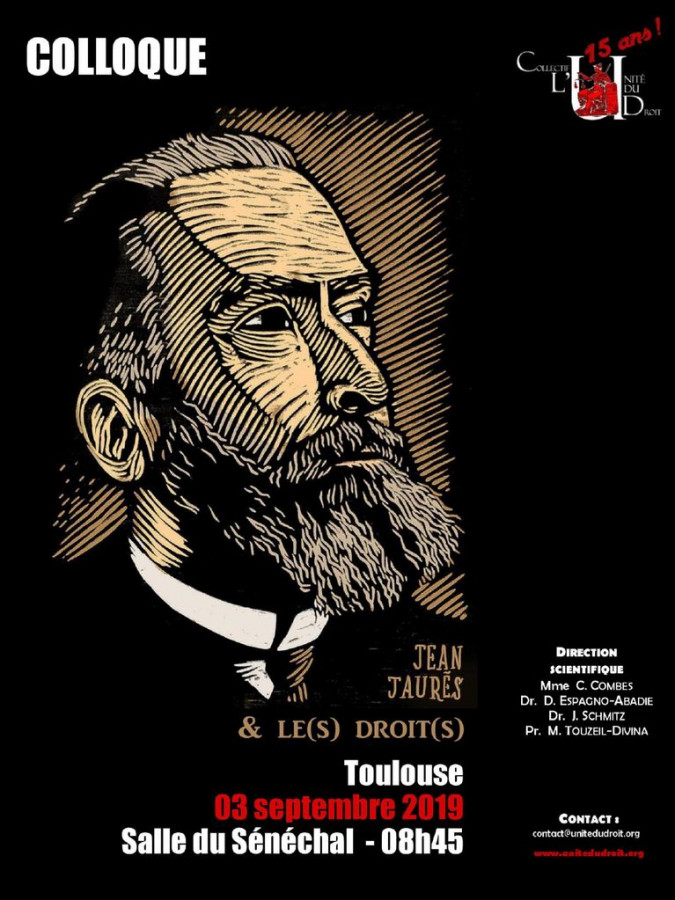
CONFERENCE: Jean Jaurès & le(s) droit(s) (Toulouse: Salle du Sénéchal, 3 SEP 2019)

(image source: univ-droit)

Conference abstract:
Le présent colloque s’inscrit dans un quadriptyque scientifique proposé par le Collectif l’Unité du droit (CLUD) à l’initiative du professeur Touzeil-Divina et ayant pour thème de réflexion(s) le(s) politique(s) & le(s) droit(s). Sont prévus en ce sens les quatre épisodes suivants :
  • Jean Jaurès (1859-1914) & le(s) droit(s) (Toulouse, 03 septembre 2019) ;
  • Louise Michel (1830-1905) & le(s) droit(s) (2020) ;
  • Charles Maurras (1868-1952) & le(s) droit(s) (2022).
  • & Charles Peguy (1873-1914) & le(s) droit(s) (2023).
Un comité scientifique et d’organisation a été institué. Il n’a pas vocation à organiser tous les colloques mais uniquement (et déjà) le premier volet Jaurèssien. Tous ses membres ont écrit ou ont procédé à des recherches relatives à JAURÈS dans des publications universitaires :
  • Clothilde Combes, Doctorante en droit public, Université Toulouse 1 Capitole
  • Delphine Espagno-Abadie, Maître de conférences à l’IEP de Toulouse
  • Julia Schmitz, Maître de conférences à l’Université Toulouse 1 Capitole
  • Mathieu Touzeil-Divina, Professeur à l’Université Toulouse 1 Capitole.
Le colloque est proposé, à Toulouse, le 03 septembre 2019 ; date anniversaire de la naissance à Castres de Jean JAURÈS (160 ans de 1859).
L’idée générale du colloque est de faire ressortir dans les écrits de JAURÈS quatre thèmes qui nous semblent opportuns en matière de droit(s) et de République(s) et ce, à partir de ses ouvrages mais également de ses discours et de son expérience en tant qu’élu. L’homme et sa doctrine ont effectivement beaucoup fait l’objet d’études historiques, littéraires, philosophiques et même sociologiques mais très peu en droit ce qui justifie la présente démarche. Evidemment, Toulouse oblige, un clin d’oeil appuyé sera accordé à l’ancrage occitan du tribun. Sont proposés en ce sens – et sur une journée d’étude - les quatre ateliers suivants :
Program:

9h00 Allocutions d’ouverture

Mot de bienvenue des organisateurs
Rappel d’éléments biographiques par des étudiants du Collectif l’Unité du droit
M. Philippe Raimbault, Professeur de droit public à Sciences Po Toulouse, Président de l’Université fédérale de Toulouse
M. Rémy Cazals, Professeur émérite d’histoire à l’Université Toulouse Jean Jaurès

10h00 - Jaurès & les Libertés

Sous la présidence de : M. Gilles Candar, Professeur de chaire supérieure en histoire, Président de la Société d’études Jaurèssiennes
Jaurès & la liberté de la presse : l’exemple des « Lois scélérates »Mme Nathalie Droin, Maître de conférences de droit public à l’Université de Bourgogne
Jaurès & la liberté de conscienceM. Patrick Charlot, Professeur de droit public à l’Université de Bourgogne
10h45 Pause

11h00 - Jaurès & l’Egalité

(présidence à confirmer)
Jaurès & « l’affaire »M. Guillaume Beaussonie, Professeur de droit privé à l’Université Toulouse 1 Capitole
Jaurès & l’Egalité par l’impôtM. Fabrice Bin, Maître de conférences de droit public à l’Université Toulouse 1 Capitole
Jaurès & l’Ecole de la RépubliqueMme Clothilde Blanchon, Maître de conférences de droit public à l’Université Toulouse 1 Capitole
12h00 Pause déjeuner

14h00 - Jaurès & la Fraternité

Sous la présidence de : M. Jacques Poumarède, Professeur émérite d’histoire du Droit à l’Université Toulouse 1 Capitole, Membre de l’association Les Amis de Jean Jaurès à Toulouse
Jaurès & les questions colonialesMme Delphine Espagno-Abadie & M. Mathieu Touzeil-Divina, Maître de conférences et Professeur de droit public à Sciences Po Toulouse & à l’Université Toulouse 1 Capitole
Jaurès, le Droit & Toulouse (de l’Université au conseil municipal)Mme Julia Schmitz & M. Frédéric Balaguer, Docteur en droit public & Maître de conférences de droit public à l’Université Toulouse 1 Capitole
15h00 Pause

15h15 - Jaurès, le(s) socialisme(s) & le(s) droit(s)

(présidence à confirmer)
Jaurès & la propriété (sociale)M. Alain Boscus, Maître de conférences en histoire, Université Jean Jaurès
Jaurès & la rationalisation du parlementarismeMme Clothilde Combes, Doctorante en droit public à l’Université Toulouse 1 Capitole

16h00 Allocutions de clôture

Jaurès & la République socialeM. Gilles Candar, Professeur de chaire supérieure en histoire, Président de la Société d’études Jaurèssiennes
Jaurès en 2019 : entre instrumentalisation et héritageMme la députée Marietta Karamanli, 2e circonscription de la Sarthe, & proposé à Mme Mélina Elshoud, conseillère départementale de la Sarthe
(source: univ-droit)

15 February 2019

WORKSHOP: Socialist interpretations of legal history. The histories and historians of law and justice in the GDR, Poland and the Baltic states under the reign of communism (22-23 MAR 2019)

(image source: helsinki)

The aim of the workshop at hand is to concentrate on the interaction between historians and communist regimes, but rather than investigating the control exercised by the communist states, we focus on the position of legal historians and their representations of history. How did the historians see the recent past, and how did that affect their vision on the future? What elements remained from the era preceding communism, and with what means did the scholars find leeway between strict ideological preconditions and their scholarly identity? 

After the Second World War, the Soviet occupied Eastern part of Germany, Poland and Baltic States all experienced – in a varying thoroughness – a drastic reorganization of higher education, which was purported to root socialist worldview to their respective academia. Consequently, in the following years also legal scholars advertised the anti-fascist, peaceable and democratizing characteristics of socialist law as an antidote to all what the western legal system supposedly encouraged and embodied. At the same time western continental legal science concentrated on the long lines of legal history, constructing its view as an exact opposite to what started to take shape as the socialist legal science. 

Rather than treating legal history and jurisprudence as mere political tools of the communist regimes, our workshop at hand focuses on the history of the scholarly representations of legal history and jurisprudence. We presume that writing the history of a community or a legal system left free space for scholars to express themselves as scientists, citizens and temporal subjects, even in communist regimes. Furthermore, we argue that this space for personal interpretation becomes evident in the works of the legal historians and legal scientists. The workshop is being arranged in a cooperation by the Centre of Excellence 'Law, Identity and the European Narratives' at the University of Helsinki and The Institut für neuere Privatrechtsgeschichte, University of Cologne. The workshop attempts to bring together scholars and approaches from variety of disciplines and fields of study. Our confirmed key-note speakers are Michal Kopecek (Jena/Prague), Marianna Muravyeva (Helsinki) and Lauri Mälksoo (Tartu). In order to analyze the ‘socialist interpretations of legal history’ in different times and regions across the Eastern Central Europe and former USSR, our workshop concentrates on (but is not restricted to) the following characteristics of socialist legal science and historiography. 

The Past, the Present and the Future in socialist legal history. What kind of narratives did the scholars reconstruct to their respected legal orders, or in general to European legal culture? How did they posit their narratives vis-à-vis the western story of European legal history, or which parts they rebuked in that narrative of the West? What were the foundational periods or agents in the socialist reconstructions and why so? 

Concepts and tropes. Where there key-concepts, tropes and metaphors in socialist legal history, and if so, where they transnational in nature or did they remain as local inventions of a national legal discipline? By whom and when they were introduced? 

The Networks and Schools in the jurisprudence of the GDR, Poland and Baltic states of the former USSR. How did the legal scholars of the former communist regimes organized themselves? Where there competing approaches to and paradigm shifts within the discipline of legal history? 

Continuities and discontinuities in socialist legal historiography. In what ways did the legal historical scholarship “started from the scratch” after 1945, distinct from bourgeois worldview and previous historical narratives? What stayed over from the inter-war period and what was rejected? How the further change in political and social conditions of the communist regimes affected legal historiography?

March 22, 2019
13.45–14.00 Ville Erkkilä, Hans-Peter Haferkamp: Opening remarks
14.00–15.00 Keynote speech, Michal Kopecek (Jena/Prague): The Socialist Conception of Human Rights and its Dissident Critique. East Central Europe 1960s-1980s.
15.00–15.30 Martin Otto (Hagen): We few, we happy few? Legal History in the GDR
15.30–16.00 Adolfo Giuliani (Helsinki): Eastern Europe and the legal historian. Changing images of the Eastern legal tradition: Roman law, canon law, Pandektism and anti-Pandektism.
16.15–17.15 Keynote speech, Marianna Muravyeva (Helsinki): TBA
17.15–17.45 Marju Luts–Sootak (Tallinn): Strategies of covert resistance in teaching and studying legal history at the University of Tartu in the Soviet era.
March 23, 2019
10.30–11.30 Keynote speech, Lauri Mälksoo (Tartu): The Concept of Human Rights in the Soviet Legal and Political Thinking.
11.30–12.00 Sanita Osipova (Riga): Valdemars Kalnins (1907-1981) – the founder of the Soviet legal history in Latvia.
13.30–14.00 Adrian Schmidt-Recla (Jena): Getaway into the Middle Ages? Topics, methods and results of socialist legal historiography in Jena
14.00–14.30 Martha Bucholc (Bonn): TBA
14.30–15.00 Anton Rudokvas (St.Petersburg): Roman law studies in the USSR
15.15–15.45 Diana Kudaibergenova (Lund): TBA
15.45–16.15 Ville Erkkilä (Helsinki): Law, Land and Community. Historicizing the socialist land reform in East Germany
(more information here)