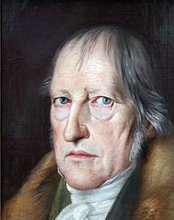
We learned of a call for papers
for an international conference on the occasion of the 200th anniversary
of the first publication of Hegel's "Grundlinien der Philosophie des
Rechts". Here the call:
The Crisis of Freedom Hegel’s
Elements of the Philosophy of Right after 200 Years
Location: Goethe University
Frankfurt
Date: January 14th –16th 2021
Conference Organizers: Christoph
Menke, Marina Martinez Mateo, Jonas Heller, Simon Gurisch, Benno Zabel
On the occasion of the 200th
anniversary of the first publication of Hegel’s Elements of the Philosophy of
Right we would like to invite you to an international conference in Frankfurt
am Main in January 2021. The conference will be structured essentially according
to the sections of the Elements. For about half of the thematic blocks we plan
to have a panel in addition to an individual lecture, and we would like to
invite scholars from philosophy, law, sociology, political science, history and
related disciplines to submit their contributions. General description The
object of Hegel’s Elements is “das Recht”. Hegel understands Recht to be
nothing else (and nothing less) than the actuality of freedom: freedom that has
become actual, that is, freedom that has actualized itself. In this sense,
Recht comprises all of (social) actuality which can in turn be understood as
the medium and presentation of freedom. Hegel’s Elements is a theory of freedom
and a theory of social actuality in one. Since the publication of Hegel’s
Elements, this unity of theory of freedom and theory of (social) actuality has
been understood as an apologetic program. This understanding was decisively
influenced by Hegel’s positioning in the political struggles of his time. After
Hegel, the critique of this reactionary positioning has fueled the program to
go back behind Hegel. Hence, a (normative) theory of freedom was played off
against a (realistic) theory of social and political reality in order to
thereby regain the possibility of critique. Yet this reaction forfeits the
specific form of critique that Hegel’s program of a conceptual unity of freedom
and social actuality opens up. For Hegel’s program is critical not because it
asserts the claims of freedom against (bad) actuality or the claims of actuality
against (false) freedom but rather through the mode in which it demonstrates
the unity of freedom and actuality: it is critical through the mode of its
presentation (Darstellung). Since it shows that the unity of freedom and
actuality only exists as a process – and that this process consists in the
bringing forth of the tensions and contradictions in which the attempts to
actualize this unity become necessarily entangled. Hegel’s Elements is thus
critical as an exposition of crises: Its argument moves from one to the next
form of right by showing and exacerbating the crisis in which every form of law
is caught up precisely because (or insofar as) it is a step in the
actualization of freedom. The exposition of crises does thus not only have a
diagnostic but a strategic, argumentative significance in Hegel’s philosophy of
right. This conference wants to focus on the crises developed in Hegel’s
Elements: the crises of abstract right, morality, family, civil society, and
the state that are each crises of the attempt to actualize freedom in these
specific forms. In doing so, the conference aims at the investigation of a
twofold problem: on the one hand, the question of the conceptual, logical
structure of Hegel’s theory of freedom and, on the other, the question of the
diagnostic, social theoretical content of his analyses of the respective forms
of right.
Call for Papers for four panels
1st Subjectivity and Irony Hegel
treats the modern theory of subjectivity, which (since Descartes) conceives of
the subject as the locus of autonomous judgment, under the title of “morality:”
“morality” means that the subject’s right to judge for itself is at stake. In
the chapter on morality of the Elements, Hegel thus negotiates the claims and
contradictions of the idea of Enlightenment (and hence of the idea of
“critique”): according to Hegel’s diagnosis, the Enlightenment strategy of the
empowerment and entitlement of the subject to autonomous judgment must fail; it
dissolves into the arbitrariness of irony. This diagnosis – often rejected as
an unfounded exaggeration (for instance in respect to its critique of Kantian
morality) – is to be reappraised anew in the context of the modern and
postmodern history of the subject as well as of the public sphere in which it
actualizes itself. Possible topics for papers (among others): the crisis of
self-determination; paradoxes of autonomy; the right of particularity;
responsibility and action; formality and arbitrariness; the theory of the evil.
Keynote: Karen Ng
2nd The Family The family is the
foundation of the ethical order as it is the first instance of the formation of
subjects. It only can perform that role, however, if or since it is at the same
time located on the threshold between nature and ethical life and in this way producing
their very difference. The family thus stands in a fundamentally ambiguous
relationship to ethical life. It is the inner Other of ethical life, without
which there can be no ethical generality, no normative and symbolic order.
Conversely, ethical life is as ineluctably referred back to the family, qua its
ground, as it goes beyond the family and dissolves it: the individuals must
step outside of the family so that there can be ethical life. How can the logic
of this contradictory relationship be understood? And in how far is Hegel’s
analysis of use in the attempt to better understand this relationship’s
contemporary crises? Possible topics for papers (among others): crises of the
family; biopolitics; ethics and politics of care; subjectivation; reproduction
and property; feminist critiques of Hegel’s Elements. Keynote: Judith Butler
3rd Civil Society Hegel’s
philosophy of the state reaches the insight of its genuinely modern standpoint
through the theory of civil society: only the conceptual apparatus of the
British political economy enables Hegel to distance himself radically from the
model of the Greek polis. In the Elements, the classical, republican ideal of
politeúein – to lead a general life – is to be developed only through the
traversing of the innermost mechanisms of a society subjected to the division
of labor. This state of ethical life – being lost in its extremes – constitutes
the material basis of the arbitrariness (Willkür) of the subjects of interest.
At the same time individuals are subjected to the interrelations of the market.
This diremption between arbitrary choice and external necessity leads in
unhindered effectiveness to the problem of the rabble and hence to the crisis
of civil society. What is the potential of this crisis theory for the present?
And what is the general significance of the theory of division (Entzweiung) for
the concept of – modern – ethical life? Possible topics for papers (among
others): the sociality of needs; freedom and necessity; isolation and
limitation of labor; poverty and rabble; outdoing and disciplining; alienation
and externalization; civil spheres of universality; the division between state
and society; Hegel and liberalism. Keynote: Axel Honneth
4th World History: Revolution and
Dialectics According to Hegel, history begins with statehood. It must be world
history since it is the relationship of states to each other; it must be
universal world history since it constitutes the process in which the universal
– freedom – actualizes itself. For Hegel, historical progress is liberation:
the overcoming of servitude. Thinking the universal historically must thus mean
to think it as revolutionary: for Hegel, history poses the question of
revolution. Linked to the question of revolution is – on the level of method –
the question of dialectics. Thus “world history” poses no less than the
question of the relationship of dialectical thinking and revolutionary
liberation. What does it mean to think the question of political universality
historically? And to what extent can the concepts deployed by Hegel be severed
from their obviously Eurocentric meaning? Possible topics for papers (among
others): “concept” and “history” as two kinds of development; world history and
the overcoming of nation states; the consciousness of freedom; liberation and
regress; Hegel and Haiti; postcolonial critiques of Hegel. Keynote: Rocío
Zambrana
Submissions: Please submit a
500-word abstract for your proposed paper and a short bio-note by 1st of June
2020. We particularly encourage women* and scholars from the Global South to
send their contributions. All abstracts and enquiries about the workshop should
be sent to:
hegelfrankfurt2021@gmail.com