
(image source: OUP)
Abstract:
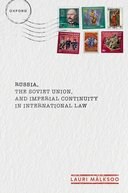
This book, a sequel to the author’s Russian Approaches to International Law (OUP, 2015), presents the history of international law in Russia and the Soviet Union, from the perspective of Russia’s imperial doctrines and practices in international law. Starting from the expansion of Muscovy in the sixteenth century and connecting the discussion with the Russo–Ukrainian war of our time, the book discusses key Russian international lawyers and their arguments against the backdrop of the Russian and Soviet history and territorial expansions. International legal doctrines such as regarding the termination of treaties (clausula rebus sic stantibus), state identity and continuity, right of peoples to self-determination, balance of power, and special status of great powers are discussed throughout the book, in the context of different historical periods. The imperial views of leading Russian and Soviet international lawyers such as Feodor Martens, Evgeny Korovin, Evgeny Pashukanis, Fedor Kozhevnikov, and Grigory Tunkin are discussed in detail. The book challenges the view that Tsarist Russia was a semi-peripheral power in the context of European international law. The book also challenges Lenin’s concept of imperialism—namely that it is the last stage of capitalism. The book maps the history of the Russian Empire and the Soviet Union in the context of international legal arguments and ideas which facilitated the continuity of the Russian Empire. By doing this, the book offers a new account of the global history of imperialism in international law by which imperialism is not tied primarily to West European Empires. The book makes extensive use of original resources from Russian and Soviet literature on international and constitutional law.
Read more here: DOI 10.1093/9780198955962.001.0001.


No comments:
Post a Comment