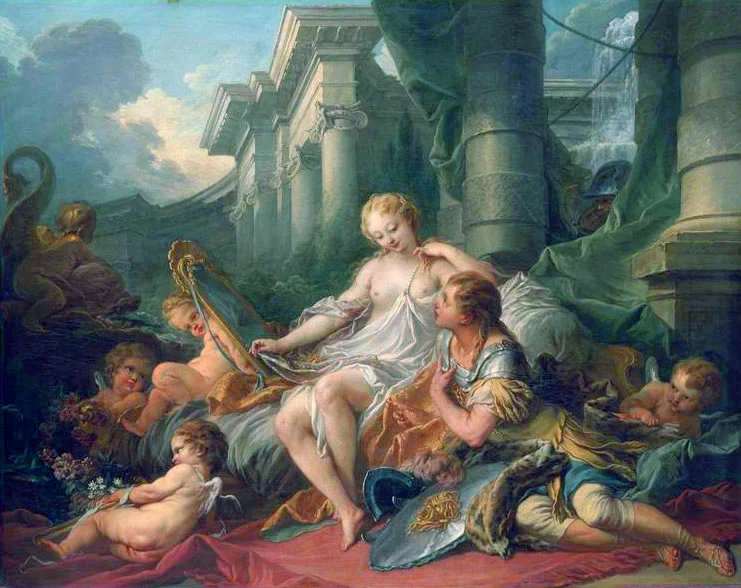
(François Boucher, Renaud et Armide (Louvre); source: Wikimedia Commons)
The ESCLH Blog wil interrupt its publications from 17 July to 15 August. We hope our readers find the occasion to relax outside with a book in the Summer Sun.

The ESCLH aims to promote comparative legal history and seeks affiliation with individuals and organisations with complementary aims.

Abstract:
This Article is the first to scrutinize presidential trade authority under the Constitution. The Constitution grants the President no independent power to regulate foreign commerce. That conclusion, while apparent from a straightforward reading of Articles I and II, stands in stark contrast to executive conduct of U.S. trade policy in recent years. This Article traces the roots of this constitutional distortion to a confluence of doctrinal drift and academic oversight. Courts and commentators have increasingly relied on an expansive conception of executive power grounded in a perceived general foreign affairs authority. In doing so, they have blurred the line between diplomacy and commerce and used this confluence to justify unilateral economic actions by a “trader in chief” that circumvent the Constitution’s allocation of power. These matters have reached a tipping point over the last decade, prompting a series of high-profile cases in which the government has argued that this general foreign affairs power includes some portion of the foreign commerce power. To correct this misapprehension, this Article undertakes a novel examination of Founding-era materials, including the distribution of commercial authority between the king and parliament in eighteenth-century Britain, the correspondence and deliberations of the Framers, and the Founding Generation’s implementation of the commerce power in matters of national security during the early years of the Republic. These sources reveal a consistent and deliberate understanding both that Congress’s control over foreign commerce is exclusive and that Congress’s control over commerce trumps the President’s general foreign affairs powers when the two intersect. This Article further argues that this allocation was not accidental or ancillary but central to the constitutional design.
Read the article in open access here.
(source: Legal History Blog)
Abstract:
La condition ouvrière, les formes de solidarités à travers le syndicalisme et le mutualisme, la période de l’entre deux-guerres et le régime de l’État français entre 1940 et 1944, les territoires anciennement colonisés par la France, tels sont les thèmes traités ici et constitutifs du droit social et de son histoire. La diversité des contributions témoigne des multiples façons dont le droit et ses acteurs peuvent être appréhendés, tout particulièrement en matière de relations du travail et de protection sociale. Avec des approches différentes, des formes et supports variés, juristes, historiens et sociologues explorent des thématiques qui ont constamment retenu l’attention de Jean-Pierre Le Crom, historien du droit, directeur de recherche émérite au Centre national de la recherche scientifique et membre du laboratoire Droit et changement social de Nantes Université (Unité mixte de recherche CNRS 6297). Publié avec le soutien de Nantes Université
Indicative table of contents:
L'Entre-deux-guerres et le régime de Vichy Le droit des colonies L'histoire du droit social La condition ouvrière Le syndicalisme et le mutualisme
See publisher's website for Table of Contents and free excerpt.

Abstract:
Oliver Wendell Holmes Jr. sat on the Supreme Judicial Court of Massachusetts in 1889, when, in the case of Claflin v Claflin, he joined the decision that a trust may not be modified if the intention of the testator would be undermined. Claflin rejected Lord Cottenham’s reasoning in Saunders v Vautier that, under certain circumstances, beneficiaries may compel the termination of the trust and transfer the property to them. Claflin v Claflin and Saunders v Vautier are perhaps the two most famous cases in Anglo-American Equity. Through a detailed examination of manuscripts, this article offers a comparative expansion of the US and English histories, and particularly considers the role played by Holmes. Re-enactment theory offers the possibility of creating, or reliving, the intellectual process that led to Claflin, thus revealing a significant moment in the history of US federalism.
To read the article, please click here. The article is available in open access; the full issue is freely accessible online to members of the European Society for Comparative Legal History.
DOI: https://doi.org/10.1080/2049677X.2026.2671607
La laïcité donne lieu aujourd’hui à de nombreux débats, à de vigoureuses polémiques et à bien des contresens. Dans ce livre érudit et exigeant, où il noue un dialogue serré avec les fondateurs ainsi qu’avec de nombreux interprètes contemporains, Vincent Peillon montre comment la laïcité française propose une version absolument singulière de la sécularisation. Ni rejet et éviction du religieux, ni réinvestissement à l’identique du religieux dans le séculier, pas davantage bricolage individuel qui permettrait à chacun de se forger ses propres croyances, la laïcité française met en œuvre un modèle de sécularisation jusqu’ici curieusement peu étudié. Ce modèle, qui définit au plus près l’exception française, est inséparablement religieux et politique, rationnel et mystique. La laïcité française ne peut se résumer à un dispositif juridique de neutralité et de séparation des Églises et de l’État. Pensée comme nécessaire pour fonder le lien civique, garantir la démocratie, émanciper l’individu et réaliser la justice sociale, elle est une religion civile qui engage une compréhension nouvelle de la modernité. Celle-ci serait le produit d’une longue histoire, celle des hérésies.
On the author:
Philosophe et homme politique, Vincent Peillon a consacré de nombreux ouvrages à Maurice Merleau-Ponty, au républicanisme, à la laïcité et à la philosophie juive française. Comme ministre de l’éducation nationale, il a mis en place la Charte de la laïcité et relancé l’enseignement moral et civique.
(source: univ-droit)

Abstract:
Bonne nouvelle ! Le guide 𝘓𝘦𝘴 𝘪𝘯𝘴𝘵𝘪𝘵𝘶𝘵𝘪𝘰𝘯𝘴 𝘱𝘶𝘣𝘭𝘪𝘲𝘶𝘦𝘴 𝘥𝘦 𝘭𝘢 𝘱𝘳𝘪𝘯𝘤𝘪𝘱𝘢𝘶𝘵é 𝘥𝘦 𝘓𝘪è𝘨𝘦 (980-1794) est désormais consultable en ligne et téléchargeable gratuitement ! Les Archives de l’État à Liège conservent de riches fonds d’archives de la principauté de Liège, mais pour y accéder, il faut connaître l’histoire, l’organisation, les compétences et les activités des institutions de l’un des États les plus singuliers de l’Europe d’Ancien Régime. L’organisation politique et administrative liégeoise (où pouvoirs temporel et spirituel s’entrecroisent) est complexe et différente des autres états d’Ancien Régime et, bien sûr, des institutions contemporaines. L’ouvrage offre une synthèse complète et structurée des institutions liégeoises -administratives, judiciaires, financières et militaires ; tant centrales (Conseil privé, États, Chambre des comptes, Cour allodiale, Cour féodale, etc.) que régionales (duché de Bouillon, comté de Looz, condominium de Maastricht, etc.) et locales (villes, métiers, échevinages, etc.). Chaque ville fait l’objet d’une notice spécifique. Chaque notice suit un cadre clair : histoire, organisation, compétences, activités, principaux textes normatifs, listes de fonctionnaires, sources archivistiques et éditions, bibliographie.
Read more here.
(source: Celida [Centre liégeois de documentation archivistique)

Volume II of The Cambridge History of International Law breaks the mould of Eurocentric histories in the field by exploring international law in Asia from antiquity to decolonisation. Its twenty-six chapters span a vast geography, covering both the landmass and the oceans; offering accounts of statecraft and diplomacy, war and trade; marriage and gift-giving; treaty-making and dispute settlement; ideas of the human and 'the other'; and entanglements of political authority with mercantile, corporate and religious orders. The chapters introduce readers to a diverse cast of characters, from scholars, scientists, geographers, mapmakers; to traders, merchants, shipowners and entrepreneurs; and to women, revolutionaries, pirates, labourers, and monks. The volume explains leading historiographical trends, ponders the challenges of writing Asian histories of international law, highlights available materials and methods, and showcases the conceptual purchase of Asian histories for thinking about international law.
Read more here: DOI 10.1017/9781009121972.

Abstract:
Established in the wake of the First World War, the League of Nations fundamentally transformed international politics, global governance and multilateral cooperation in a multitude of fields from the economy, labour and social affairs to colonial, minority and security questions. This Handbook analyses the central role of law in the construction of a new international order under the League of Nations. Drawing from innovative research of recent years that analyses the League of Nations through the prism of ultimate success and failure, it offers twenty-one rich chapters that showcase an interdisciplinary, contextual and archive-based approach with brand new and unexplored case studies that address key topics of the legal history of the League, the International Labour Organization and the Permanent Court of International Justice. Finally, it offers a new historical synthesis of how to understand the role of international law in international organizations during the interwar period.
Read more here: DOI 10.1017/9781009655149.

The French legal history journal Clio@Themis has published its latest issue, devoted to “Le(s) temps de la justice (XVe–XXe siècle)”.
Contents/Articles:
The full issue is available in open access here: https://journals.openedition.org/cliothemis/6543Alice Bonzom, Simon Castanié, Nicolas Picard, Benoît Saint-Cast and Verónica Vallejo Flores
Introduction
Bernard Dauven
L’usage du temps par les justiciables à la fin du Moyen Âge. Les délais des compositions pour homicide dans les Pays-Bas bourguignons (sources, méthode et difficultés critiques)
Dylan Beccaria
Temps procédural et usages de la justice au XVIIe siècle. Étude de la vérification des lettres de grâce par les juridictions provençales
Louis Georges
De jour et de nuit : le Châtelet de Paris, une justice temporalisée ? Mesure, réformes, et pratiques du temps horaire dans les procédures criminelles parisiennes (XVIIe–XVIIIe siècles)
Fanny Lalande
Graffitis des prisons d’État de Crest et de Beauregard : mise en récit du temps de l’emprisonnement chez les prisonniers pour religion au XVIIIe siècle
Fabien Salducci
Célérité judiciaire et refonte du modèle de justice de proximité : l’exemple tropézien (1773–1803)
Federico Del Giudice
Del procedimiento sumario a los tribunales laborales. El tiempo de la justicia en los conflictos de trabajo en la Argentina en la primera mitad del siglo XX
Fabien Lostec
Les temps de la justice : un enjeu central de l’épuration en France à la Libération
Varia
Éric Seizelet
Les coutumiers japonais de la première moitié de l’ère Meiji et la codification du droit civil
Frédéric Blasi
La fabrique française du droit d’auteur et le rapport Reda, étude d’une controverse
Abstract:
The ancient Greek world was permeated with international law, the binding rules of behavior that Greeks across the Mediterranean followed and enforced for centuries. But why was international law effective in this world? Laws of All the Greeks offers an original answer rooted in contemporary social theory, presenting a definitive account of ancient Greek international law while delving into the social and psychological foundations that made it potent and durable. Challenging recent claims that international law did not exist in the Greek world, Laws of All the Greeks makes a robust case not only for its existence, but for the importance of taking ancient Greek international law as an historical subject in the first place. It provides an updated history of select elements of that law, including the right to private self-help; judicial treaties known as symbola; and piracy. Combining the findings of recent scholarship on Greek history, identity, and social networks, novel readings of documentary and literary sources, and the lessons of sociology and psychology, Jesse James demonstrates how the webs of identity binding the Greek world together affected both the rules of international law and their effectiveness at guiding legal and economic behavior. This study thus complicates and enriches prevailing approaches that emphasize formal institutions, structural features, or economic rationalism, offering instead a model for applying legal sociology to the historical study of international law.
Table of contents:
Part I. Background and Framework
1:Introducing Greek International Law
2:The Reality of Greek International Law
3:Psychology, States, and International Legal Socialization
4:International Identity and Socialization in Ancient Greece
Part II. Syla and Symbola: International Law and Commerce
5:Syla: Approaching Legal Self-Help in the Greek World
6:Syla as Self-Help in Greek International Law
7:Symbola: Social Origins of a Legal Institution
8:Symbola from the Athenian Empire to the Hegemony of Rome
Postscript
Part III. Expanding the View
9:Piracy
10:Oaths
11:The Thessalian Koinon as an International Legal Structure12:Conclusion
On the author:
Jesse James is a historian, lawyer, and Classicist. He earned his J.D. at the University of California, Berkeley School of Law and practiced law for several years in Manhattan, litigating disputes at state, federal, and international levels. He then earned his Ph.D. in Classics at Columbia University. He has held fellowships at Harvard Law School, the American School for Classical Studies at Athens, the Columbia Institute for Ideas and Imagination in Paris, and the Kommission für Alte Geschichte in Munich.
Read more here.
Il volume offre in maniera organica e coordinata un’immagine complessiva e interdisciplinare del diritto sanitario tra Otto e Novecento. Il diritto alla salute si compone anche del diritto della salute, ovvero di quel vastissimo insieme di principî, norme di rango diverso, prassi e procedure che reggono e conformano l’ordinamento sanitario. La ricerca ha inteso indagare perché e come il diritto sanitario ha svolto quello che si potrebbe definire un ruolo “costituente” in grado di disciplinare, organizzare e tutelare il bene salute dal periodo di formazione e di sviluppo dello Stato italiano sino all’età contemporanea. È una storia che – di fronte ad una sanità pubblica che rischia da tempo di essere depotenziata – ci ricorda quanto lungo e difficile sia stato il cammino per edificare e consolidare un’idea di sanità pubblica democratica e solidale.
About the editor:
Luigi Lacchè is Full Professor of Legal History at the Department of Law of the University of Macerata.
Table of contents:

Abstract:
Comment « abolir la misère par une réforme du droit » ? Cette définition surprenante du socialisme, proposée en 1897 par Charles Andler, ouvre sur une voie méconnue de la pensée sociale : le socialisme juridique. Loin des révolutions violentes et des transformations économiques radicales, ce courant intellectuel mise sur l’État et ses instruments juridiques pour parvenir à la justice sociale. Cet ouvrage collectif explore un moment charnière de l’histoire des idées, ces « années électriques » du tournant du XXe siècle où socialistes et juristes français découvrent, souvent à travers l’œuvre d’Anton Menger, que le droit peut devenir un levier de transformation sociale. Des balbutiements avec les jugements du « bon juge » Magnaud et les travaux de la première Internationale socialiste, aux vives réactions suscitées par cette approche réformiste, jusqu’à l’examen de sa postérité, l’enquête révèle une richesse théorique largement oubliée. Réunissant historiens du droit et spécialistes de la pensée socialiste, cette recherche collective restitue un pan méconnu de la culture intellectuelle française et interroge la capacité du droit à porter un projet de société. Elle éclaire d’un jour nouveau les débats contemporains sur le rôle de l’État social et la portée transformatrice des normes juridiques.
Read more here.
The principal goal of this article is to address the reception of William Blackstone's legal thought and the awareness of his contributions within the context of nineteenth-century Polish legal scholarship. Despite the considerable differences between English and Polish legal traditions, the limited proficiency in the English language within Poland, and the relatively gradual evolution of Polish legal thought, Blackstone's works were acknowledged by academic circles in Poland in the nineteenth century. Over time, this awareness manifested in direct engagement with certain aspects of Blackstone's perspectives. Nonetheless, the temporal disparity between Blackstone's period of influence and the evolution of legal scholarship in partitioned Poland significantly limited the practical opportunities for the integration and application of Blackstonian jurisprudence.
El presente libro tiene como objetivo responder a una pregunta fundamental: ¿Qué es el humanismo jurídico? Tras la introducción de Xavier Prévost y Luigi Alberto Sanchi, se recogen las reflexiones de Patrick Arabeyre, Mario Ascheri, Diego Quaglioni, Italo Birocchi, Wouter Druwé y Rafael Ramis Barceló, quienes abordan las cuestiones esenciales desde una amplia perspectiva europea. A continuación, se presentan, como estudios de caso, dos traducciones al francés —realizadas por Philippe Cocatre Zilgien y Théo Crea— de obras de dos célebres humanistas: François Douaren y Eguiner Baron. The present book seeks to answer a fundamental question: What is legal humanism? Following the introduction by Xavier Prévost and Luigi Alberto Sanchi, the volume brings together contributions by Patrick Arabeyre, Mario Ascheri, Diego Quaglioni, Italo Birocchi, Wouter Druwé and Rafael Ramis Barceló, who address the essential issues from a broad European perspective. The book then offers, as case studies, two French translations—prepared by Philippe Cocatre Zilgien and Théo Crea—of works by two renowned humanists: François Douaren and Eguiner Baron.
Table of contents:
Introduction / Xavier Prévost, Luigi Alberto Sanchi (pp. 9-18). -- De quoi le bartolisme est-il le nom? / Patrick Arabeyre (pp. 19-40). -- Umanesimo giuridico e crisi del diritto comune / Mario Ascheri (pp. 41-50). -- Umanesimo giuridico e senso della tradizione / Diego Quaglioni, Saxum Sysyphi (pp. 51-62). -- Il problema della definizione dell’umanesimo giuridico: uno specchio per lo storico del diritto / Italo Birocchi (pp. 63-82). -- L’humanisme juridique dans le contexte des Pays-Bas méridionaux / Wouter Druwé (pp. 83-98). -- El humanismo jurídico: definición, etapas y categorías para su estudio / Rafael Ramis-Barceló (pp. 99-134). -- François Douaren, De docendi discendique iuris ratione (1544) : proposition de traduction / Philippe Cocatre-Zilgien (pp. 135-194). -- La préface De ratione docendi discendique iuris civilis, ad iuventutem écrite par Eguiner Baron / Théo Crea (pp. 195-202)
More information and open access PDF available here.
Throughout history, law and literature have always been in constant dialogue, sharing significant connections and exerting mutual influences. Both are artificial creations, products of human imagination that use language and metaphors to build meanings and shape the world around us. In the Middle Ages, the proximity of these two genres is even more pronounced. This is not only because many literary figures were also jurists, but also because medieval legal texts can be classified as a distinct literary genre known as ‘legal literature’. Additionally, medieval jurists did not hesitate to draw upon literary texts, understood as genuine sources of law (‘auctoritates morales’), to fill gaps in their legal knowledge. The contributions collected in this volume examine precisely this intersection between law and literature in medieval literary and legal texts. The volume follows four axes: law in literature, law as literature, literature in law, and literature as Law. The volume aims to raise awareness of the proximity of two apparently distant worlds and to provide a perspective for interdisciplinary analysis that transcends traditional rigid barriers.
Table of contents:
Foreword Sara MENZINGER Introduction Ignazio ALESSI and Gavino SCALA ‘Par bataille ou par juise’. Ordeal by Combat in Thirteenth-Century Arthurian Prose Romances Claudio LAGOMARSINI La fiction judiciaire amoureuse (XIIe-XVe s.). Enjeux procéduraux Cassandre CRESPIN (Don’t) call me by your name. Lexical Gleanings of Droit Non Marta MILAZZO Procès du loup, procès de l’homme. La justice dans ‘Le valet aus douze femes’ Federico NOVELLO Le meurtre de Lancelot Ier dans la fin particulière des témoins Paris, Ars. 3348 et New Haven, Beineke Library, MS 227 de l’Estoire del Saint Graal. Une vendetta à l'épreuve du droit féodal Davide NOVATI Acoustic Effects and Kinesic Imagination in Archbishop Wulfstan of York’s Legal Writing Chen CUI Exploring Legal and Linguistic Dimensions in Late Medieval English Jurisprudence. William Lyndwood’s Provinciale and Inheritance Practices Matthew CLEARY Conclusions. Literature as a Field of Legal Experimentation Noëlle-Laetitia PERRET and Adrien WYSSBROD
On the editors:
Ignazio Alessi is a Research Fellow at the Centre for Research in the Arts, Social Sciences and Humanities (CRASSH), University of Cambridge, and a Postdoctoral Research Associate at Trinity Hall. He holds a joint Ph.D. in legal history from the EHESS in Paris and the University of Palermo. He was a postdoctoral researcher at the Universities of Fribourg and Geneva, and a visiting scholar at the Centre Relais Culture Europe in Paris and at Wolfson College, University of Oxford. Gavino Scala is a postdoctoral researcher at University of Geneva. He has a joint Ph.D. in Romance Philology at University of Siena and University of Zurich. He was postdoctoral researcher at University of Fribourg (CH).
Read more here.

(Image source: University of Canterbury, https://www.canterbury.ac.nz)
Dates:
3 – 5 December 2026
Location: The
University of Canterbury, Christchurch, New Zealand
Conference theme: ‘Oral
sources and Non-traditional legal sources’
Legal historians have
traditionally looked to cases, statutes, and juristic literature. Yet the
history of law has never been confined to such conventional legal sources. The
use of oral sources and non-traditional materials raise important methodological
questions for legal historians: what counts as a legal source? and how might
law and history be written differently?
The 2026 conference theme
invites consideration of oral sources and non-traditional legal sources, in
every sense, in the context of law and history. Some conference streams will
focus specifically on oral sources, including oral testimony, oral history,
memory, storytelling, folklore, and intergenerational transmission. The theme
invites participants to reconsider the sources of law and history.
Oral sources are
especially important for histories of Indigenous law. We invite papers on
tikanga Māori, Aboriginal and Torres Strait Islander customary law, and
practices grounded in kinship, place, obligation, authority, and procedure.
Such work may examine how colonial legal systems have misunderstood,
appropriated, suppressed, or transformed Indigenous legal knowledge.
The conference also
invites engagement with non-traditional legal sources more broadly, including
newspapers, petitions, letters, council decisions, archival records, folklore,
family histories, demographic material, and socio-economic data. Newspapers, for
example, were forums in which trials were reported, in which the reputations of
parties could be sensationalised, and by which communities could engage with
the law. In essence, newspapers and other non-traditional sources can
illuminate how law was experienced in everyday life.
This conference invites
participants to explore oral and non-traditional legal sources. Themes may
include: the challenges of using oral and non-traditional sources; customary
law; the relationship between memory and the law; and the role of non-traditional
sources to explore law and society.
Papers are welcome from
all periods, jurisdictions, disciplines, and methodological approaches. We also
welcome papers that are outside of the conference theme.
This conference is a
co-hosted event supported by Monash University and the University of
Canterbury.
Call for Paper Guidelines
On behalf of ANZLHS, the
Conference Organising Committee cordially invites papers from any period or
geographical area, and from all disciplines and fields, including but not
limited to law, legal theory, history, political science, indigenous studies, gender
studies and law and literature.
Papers are invited on any
topic, but the conference organisers particularly welcome abstracts addressing
the conference theme of ‘Oral Sources and Non-Traditional Legal
Sources’.
Please note presenters
must be members of ANZLHS before their papers are presented. You can join or
renew here: https://anzlhs.org/join-us/.
An Early Career
Researcher (ECR) session will be held on Thursday 3 December 2026. Details will
follow.
If you are an ECR, please
indicate your interest in attending the session when submitting your abstract.
Graduate students may apply for Kercher Scholarships to support their
attendance at the conference. Please contact the Organising Committee at anzlhs2026@gmail.com by Monday 6
July 2026 to express interest in this scholarship. Graduate students and other
ECRs may also wish to enter for the Forbes Society Prize (see https://anzlhs.org/francis-forbes-society-for-australian-legal-history-annual-prize/).
Please notify the conference conveners of your intention to apply for the
scholarship at the time of submitting your abstract.
The Society’s
peer-reviewed journal law&history (see https://anzlhs.org/journal/) will
consider submissions from those who present papers at the conference.
Registration details and
accommodation options in Christchurch will follow.
Abstracts should be no
more than 300 words and should be accompanied by a short biography (100 words).
Panel submissions are also warmly encouraged. Submissions should be sent
to anzlhs2026@gmail.com.
We look forward to
receiving your abstracts by Monday 20 July 2026. Acceptances will
be communicated by 17 August 2026.
.jpg)
The University of Edinburgh decided to award an honorary doctorate to Prof. em. dr. Jean-Louis HALPÉRIN (ENS Paris). The ceremony took place on 8 July 2026.
(source: University of Edinburgh)

Call for papers – Aufruf zur Einreichung von Beiträgen
„Junge Juristen entlang der Donau“
Rechtsvergleichende Konferenz zwischen den Donauregionen
Győr, 16.–18. November 2026
Veranstaltungsort:
Széchenyi István Universität Győr
Organisatoren:
Deák Ferenc Fakultät für Staats- und Rechtswissenschaften der Széchenyi Universität Győr, Magyar-Német Ifjúságért Egyesület – Deutsch-Ungarisches Jugendwerk e.V., Institut für Ostrecht
Partner:
Universität Regensburg, Universität Passau, Hochschule für Angewandte Wissenschaften Hof, Universität Augsburg, Universität Wien, Andrássy Universität Budapest, Deutsch-Ungarischer Jugendrat
Das Deutsch-Ungarische Jugendwerk hat letztes Jahr das erste Deutsch-Ungarische Jugendparlament veranstaltet. Dieses Jugendparlament hat sich u.a. die Realisierung eines juristischen Forschungsprojekts für Jugendliche entlang der Donau zum Ziel gesetzt. Das Jugendwerk möchte dieses Vorhaben mit den Partneruniversitäten Regensburg, Augsburg, Passau, Wien, Győr und der Andrássy Universität Budapest sowie der Hochschule Hof und dem vom Jugendwerk gegründeten Deutsch-Ungarischen Jugendrat verwirklichen und so junge Rechtsstudierende zusammenbringen, um gemeinsam ein Verständnis für die verwandten Rechtssysteme zu erarbeiten.
Die Rechtsordnungen Deutschlands, Österreichs und Ungarns teilen gemeinsame europäische Ideen und Wurzeln, weisen jedoch in ihrer Struktur und der aktuellen rechtspolitischen Dynamik deutliche Unterschiede auf. Diese Unterschiede werden in der öffentlichen Debatte häufig diskutiert, während ein direkter fachlicher Austausch zwischen jungen Studierenden bislang nur vereinzelt stattfand. Insbesondere mit Blick auf gesamteuropäische Herausforderungen besteht ein wachsender Bedarf an Verständnis für die jeweiligen Systeme sowie an rechtsvergleichender Expertise. Diese rechtsvergleichende Konferenz bietet eine multilaterale Plattform, um einen strukturierten und wissenschaftlich fundierten Austausch zu ermöglichen.
In diesem Rahmen können unter Anleitung der fachlichen Experten und Expertinnen mehrere Rechtssysteme der Vergleichenden Rechtswissenschaft erarbeitet und nachvollzogen werden. Dadurch sollen außerdem die rechtsvergleichenden Kompetenzen der Teilnehmenden gestärkt sowie eine zukünftige Netzwerk-Plattform geboten werden.
Ziel der Organisatoren ist auch die spätere wissenschaftliche Veröffentlichung der Ergebnisse der Konferenz. Damit dient die Veranstaltung nicht nur als fachliches Treffen, sondern auch als Ausgangspunkt einer längerfristigen wissenschaftlichen Zusammenarbeit und eines jungen Juristennetzwerks.
Die Organisatoren halten es für wichtig, den wissenschaftlichen Dialog durch die Einbeziehung von Vertretern verschiedener wissenschaftlicher Disziplinen und geografischer Regionen, die mit dem breiten Thema in Verbindung stehen, zu stärken. Dabei ist es ein wesentliches Ziel, auch den interdisziplinären Austausch zu fördern und Perspektiven aus verschiedenen Rechtsgebieten, der Politik sowie den benachbarten Disziplinen zu eröffnen.
Das Programm der Konferenz baut auf thematischen Sektionen auf, in denen die jungen Teilnehmenden ihre Forschungen in Form von Kurzvorträgen präsentieren können.
Wir sind auf der Suche nach Beiträgen, die sich aus möglichst vielfältigen fachlichen Blickwinkeln heraus den Sektionsthemen nähern. Das geplante Forschungssymposium bietet Gelegenheit, aktuelle Forschungsarbeiten zu den Themenfeldern der jeweiligen Sektionen zu präsentieren und zu diskutieren.
Der Aufruf zur Einreichung von Abstracts richtet sich an Studierende und junge Wissenschaftlerinnen und Wissenschaftler, die am Anfang ihrer akademischen Karriere stehen. So freuen wir uns auf Einreichungen von Studierenden und Promovierenden zwischen 18 und 35 Lebensjahren.
Für die Vorträge sind jeweils Zeitfenster von 15–20 Minuten vorgesehen, den Vorträgen folgt eine fachliche Diskussion. Die Präsentationen finden auf Deutsch statt. (Wir bieten ungarischen Muttersprachlern die Möglichkeit, komplexe Fragen mithilfe eines Übersetzers zu beantworten.)
Anschließend ist eine Publikation in Form einer wissenschaftlichen Studie (25.000–40.000 Zeichen) geplant, die die Konferenzergebnisse zusammenfasst.
Die Veröffentlichungen werden voraussichtlich in den folgenden Fachzeitschriften erscheinen:
Montag, 16.11.2026
Dienstag, 17.11.2026
Mittwoch, 18.11.2026
Für Unterkunft und Verpflegung während der Konferenz ist gesorgt. Die Reisekosten werden nach der Konferenz erstattet und können in folgender Höhe übernommen werden:
Wir empfehlen ausdrücklich die Anreise mit nachhaltigen Verkehrsmitteln wie Zug oder Fernbus. Wir können leider keine Kostenerstattung bei der Anreise mit dem Auto übernehmen.
Bitte beachten Sie außerdem, dass der Abschluss einer ausreichenden Kranken-, Haftpflicht- und Unfallversicherung sowie die Gültigkeit der benötigten Ausweisdokumente (Personalausweis/Reisepass) in der Verantwortung der Teilnehmenden liegen.
Bitte senden Sie bis zum 25. August 2026 ein Abstract (max. 500 Wörter, Kurzbeschreibung des Forschungsprojekts und thematische Zuordnung zu einem der genannten Schwerpunkte) sowie eine kurze Biografie (max. 100 Wörter) an die E-Mail-Adresse:
Eine Rückmeldung über die Teilnahme erfolgt bis Mitte September.
Wir freuen uns auf interessante Vortragsideen und darauf, Sie im Herbst 2026 in Győr begrüßen zu können. Bei Rückfragen zur Ausschreibung stehen wir Ihnen unter donaukonf@sze.hu zur Verfügung!
Deák Ferenc Fakultät für Staats- und Rechtswissenschaften der Széchenyi Universität Győr
Magyar-Német Ifjúságért Egyesület – Deutsch-Ungarisches Jugendwerk e.V.
Institut für Ostrecht

(image: Chained books in Duke Humfrey’s Library, Bodleian Library, Oxford. Photo: Philip Opher. Source: History of the Bodleian illustrated brochure, p. 8).
Oxford University Press has launched Oxford Bibliographies in Legal History, a new online resource edited by Gautham Rao.
The project aims to provide scholars and students with authoritative guides to the central themes, methods, and literature of legal history. According to Oxford University Press, the field of legal history now encompasses not only courts, lawyers, and doctrine, but also institutions, governance, power relations, social and family relations, identities, ideology, and the lived experiences of social, religious, and cultural minorities.
Oxford Bibliographies in Legal History forms part of the broader Oxford Bibliographies platform, a curated collection of research guides that is continuously updated by a community of scholars and researchers. The Legal History module is intended to offer accessible introductions, selected bibliographies, and guidance on both classic and recent scholarship in the field.
Oxford University Press also invites members of the wider academic community to become involved in the project. Authors, scholars, librarians, and students are encouraged to contribute, provide insights and recommendations, or contact the editorial team with questions and suggestions.
The Editorial Board is headed by Gautham Rao as Editor-in-Chief. The Area Editors are Alison L. Lefkovitz (Rutgers), Keramet Reiter (University of California Irvine), Mattias Åhrén (Lund University), Teri McMurty-Chubb (University of Illinois Chicago), and Tamar Herzog (Harvard University).
Those interested in contributing or contacting the editorial team may write to: LegalHistory.OxBib@oup.com
More information is available on Oxford Academic.
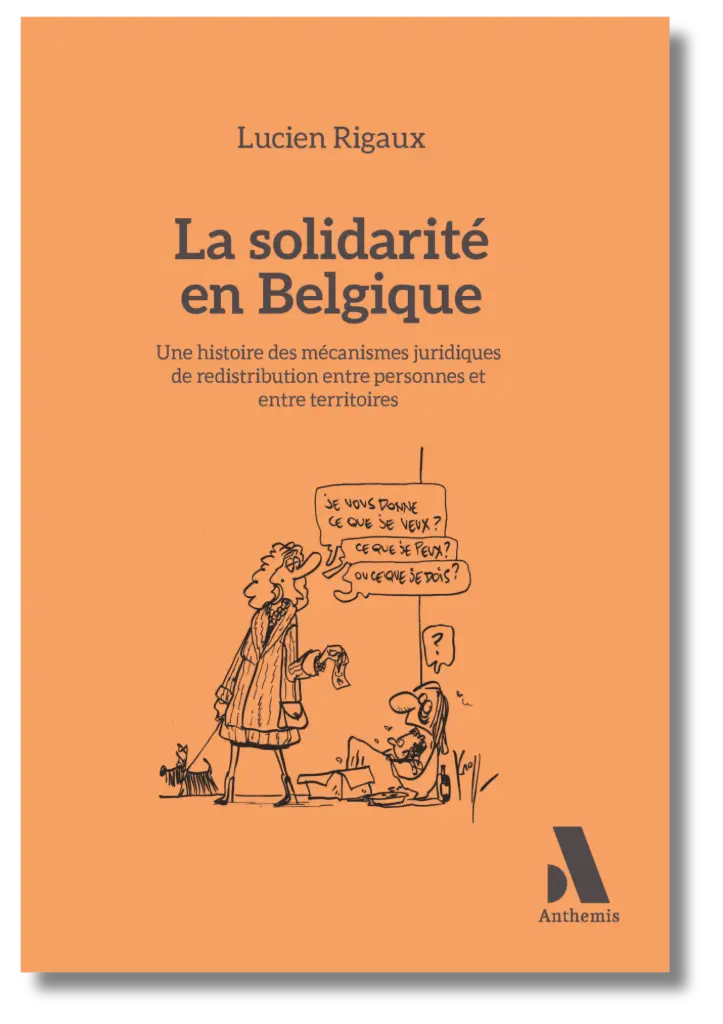
Pourquoi payons-nous des impôts ? Pourquoi la solidarité est-elle devenue un droit… et une obligation ? De la charité volontaire à l’État social, cet ouvrage retrace l’histoire fascinante de la solidarité en Belgique et interroge son avenir à l’heure des crises, du fédéralisme et de la mondialisation. Aux origines de nos impôts, de notre sécurité sociale et des transferts entre territoires : un principe essentiel, celui de la solidarité. Comment la Belgique est-elle passée d’un modèle de charité libre et volontaire à un régime de solidarité structuré, fondé sur des droits et des obligations ? Quels événements, quels choix politiques et économiques ont façonné notre système de redistribution entre personnes et entre territoires ? Issu d’une thèse de doctorat en droit saluée pour son originalité et la richesse de sa documentation historique, juridique et économique, cet ouvrage retrace les grandes transformations de la solidarité en Belgique, des origines aux défis contemporains. Lucien Rigaux explore les moments de ruptures – crises économiques, guerres, montée du libéralisme, revendications nationalistes – qui ont redéfini les contours de la redistribution, tout en mettant en lumière les dynamiques paradoxales qui traversent l’État belge : désintégration fédérale d’un côté, intégration européenne de l’autre. À travers une plongée passionnante dans les mécanismes fiscaux, les dispositifs de sécurité sociale et les transferts interterritoriaux, l’auteur interroge les rapports entre capacités contributives et besoins sociaux, tout en se livrant à l’exercice ambitieux de mettre en perspective la solidarité interpersonnelle et la solidarité interterritoriale. À travers l’étude des régimes de solidarité, il offre ainsi une lecture vivante et nuancée de l’histoire sociale, économique et institutionnelle de la Belgique, et surtout une réflexion plus large sur le rôle de la redistribution dans une économie de marché mondialisée où les interdépendances se renforcent, mais où persistent des défis majeurs : concurrence fiscale, soutenabilité des systèmes sociaux, replis identitaires et quête de justice sociale. Destiné aux juristes, économistes, chercheurs en sciences sociales ainsi qu’à tout lecteur curieux de comprendre les inégalités et les outils dont nos sociétés disposent pour y répondre, ce livre propose des clés précieuses pour appréhender les enjeux actuels de la solidarité et imaginer ses évolutions possibles. Au-delà des chiffres et des normes, il invite à réfléchir sur ce qui, collectivement, nous relie.
On the author:
Lucien Rigaux s'est vu décerner le Prix Joseph Hubert HELSEN en mai 2025. Plus qu'une analyse technique, son étude a été récompensée pour sa vision novatrice et son engagement en faveur du progrès humain, offrant des pistes de réforme audacieuses pour l'évolution de notre société.
Read more with the publisher.

Two open access volumes on the University of Leuven/Louvain in the late Middle Ages and Early Modern Age have been published recently.
Innovationes Lovanienses: Arts, Law and Theology at the University of Louvain (1425–1797) (eds. Violet Soen, Wouter Druwé, Wim François & Ralph Deconinck)
DOI 10.1484/M.LECTIO-EB.5.145524
Abstract:
Throughout the first centuries of its existence, the University of Louvain functioned as a crossroads for the transmission of texts, ideas, and even images from Antiquity, across the Middle Ages, and through the Renaissance. From its foundational bulls between 1425 and 1432, the university was established as a prototypical studium generale, drawing inspiration from earlier institutions in Paris and Cologne and adopting elements from contemporary universities like Rostock and Geneva. Situated at the heart of Europe, the University of Louvain quickly became a pivotal center for the reception and dissemination of both ancient and contemporary knowledge across the continent, and later, the Habsburg Empire. This volume examines how teachers and students examined old and innovative ideas across various constituent bodies of the university, including the Faculty of Arts or the College of the Three Tongues, or neighboring institutions, like the Jesuit College. Contributions span the Faculties of Law, adopting insights on the newly promulgated Tridentine decrees or novel moral economies, to the Faculty of Theology, a hotbed of the controversies surrounding grace, free will, and salvation in post-Tridentine Catholicism. Of the many scholars that were active in Louvain, special attention is devoted to the philologist Petrus Nannius, the theologians Michael Baius and Jacobus Janssonius, the lawyers Petrus Peckius and Johannes Wamesius, and the Jesuits Robertus Bellarminus and Leonardus Lessius, along with the lectures they gave at the Louvain house of their Order.
Chapters
Students, Scholars and Their Books at the University of Louvain (1425–1797) (eds. Violet Soen, Wouter Druwé, Wim François & Ralph Deconinck)
DOI 10.1484/M.LECTIO-EB.5.145522
Abstract:
Integrating prosopographical, cartographical, and book-historical data, this collective volume on the first University of Louvain (1425–1797) contributes to ongoing interdisciplinary inquiries into the intellectual productions of students, scholars, and printers in the Early Modern era. The ten contributions examine the state of the art at the University of Louvain, whose output was supported by the vibrant printing presses of the Low Countries and the continual mobility of its scholars across continental Europe. The essays first unravel the transregional circuits of Louvain’s students, scholars, and printers, built upon their geographical mobility throughout Europe. The second part explores how early modern students at Louvain created their study materials by compiling lecture notes, rearranging the contents, and binding them into codices, often adorned with drawings or printed engravings – a practice that remained prevalent until the eighteenth century. Further contributions trace the introduction of the handpress to the city of Louvain, which, beginning in 1473, brought new opportunities for producing textbooks for broader markets, as typography and physical features transformed handbook production. Louvain’s publication network was especially dense in the sixteenth century, and publication rates remained high through the eighteenth century. This volume offers new insights into the hybrid world of oral teaching, handwritten note-taking, and printed textbook production by students, scholars, and printers at one of Europe’s intellectual crossroads.
Chapters


